

When reading an article or a definition about aikido, one obviously finds a great deal of information about its founder, Ueshiba Morihei. Many of our teachers often look up to this man they never met in order to justify not only technical, but also moral choices. However, what few people know or accept is the fact that aikido, as it is practiced today around the world, owes not only to Morihei, but also to a large extent to his son Kisshomaru. In reality, Morihei never really systematically taught to anyone (a topic that would be worth an entire article) and it is Kisshomaru whose task became to ensure that aikido could be appreciated and understood by the general public. Without his work, it is likely that the majority of us would not know aikido today and that the art would either be practiced in a confidential manner, or would have disappeared entirely. Ueshiba Morihei having relocated far from Tokyo during the middle of World War II, Kisshomaru had, in the midst of a very unfavorable period, to take over from a genius father, but one whose character and life choices were far from easy to follow. Today I would like to tell you a bit more about the second doshu of aikido and to review the extent of the work he has accomplished when succeeding to his father, hoping to make you understand the reason why he is rightfully regarded, in Japan and elsewhere, as the true father of aikido as we practice it today.
Birth and Childhood
Ueshiba Kisshomaru was born on June 27, 1921 in the Kyoto Prefecture. He is the fourth child of Ueshiba Morihei and his wife Hatsu, their third sonKisshomaru's his two eldest brothers died in childhood. At that time, the Ueshiba family is living in the city of Ayabe near Kyoto, in the Omoto-kyo religious community, within which Morihei occupies important functions. Morihei teaches daito-ryu aiki-jujutsu in his own school, the Ueshiba Juku. In 1927, the Ueshiba family moves to Tokyo into a rented house whose 18 tatami centerpiece also serves as a training space in the morning. Kisshomaru does not attend practice regularly but he is informally taught some basics, such as the techniques that we refer to today as ikkyo or nikyo.
 Ueshiba Kisshomaru with his father in the garden of the Ueshiba Juku in 1925.
It is important to note that Kisshomaru spends most of his childhood in a country that has been in a state of war since the invasion of Manchuria in 1930, which will last until the capitulation of 1945. Given the close ties that his father holds with the political and military class, particularly within the ultra-nationalist circles, Kisshomaru is a prime witness of the Japanese war effort politics. This experience and the harshness of postwar life will have a very important influence on his views as an adult.
 The founder with members of the Imperial Marine on board of the Mikasa war ship (1940).
The Kobukan Years
In April 1931, the construction of the Kobukan, a 80-tatami dojo located in Ushigome's Wakamatsu-choAt the same location as today's Hombu Dojo, in the Shinjuku ward. reaches its ends and this marks the beginning of intensive budo activities.For more information on this period, you can read the History of the Aikikai Hombu Dojo. The building serves as a dojo, but also as the residence for the Ueshiba family. Later, up to 20 uchi deshi live on the premises. Most of them are high-level practitioners issued from judo and kendo and some are forces of nature weighing more than 80 kilos. The frenetic activity and intensive, sometimes punitive, workouts quickly earn the dojo the epithet of "Hell Dojo of Ushigome" (Ushigome no jigoku dojo, 牛込の地獄道場).
 Inauguration of Kobukan in April 1931. First row on the left: Ueshiba Hatsu and Ueshiba Kisshomaru. Sitting in the center: Ueshiba Morihei, Admiral Asano Seikyo, Admiral Takeshita Isamu, and General Miura Makoto.
It is in this dojo, circa 1936, that Kisshomaru formally starts practicing aikido. He has studied kendo during childhood, as well as Kashima Shinto-ryu kenjutsu, and his ability to wield the sword prompts his father to use him as uke tachi during the frequent demonstrations that he gives in front of the military and political elite of the country. Much of the instruction in weapons that Kisshomaru receives from this period onwards comes from his father. Note that Kisshomaru appears as uke for Morihei in the book Budo published in 1938.
 Weapons practice between O Sensei and Kisshomaru.
Despite enjoying a privileged position alongside the founder, Kisshomaru is not being groomed by Morihei as his successor. It is actually the husband of Morihei's daughter, Nakakura KiyoshiNakakura Kiyoshi (中倉 清, 1910 – 2000) was a Japanese practitioner of kendo, iaido and aikido. He married Ueshiba Morihei's daughter Matsuko in 1932 and was legally adopted into the Ueshiba family, taking the name Ueshiba Morihiro. While Nakakura was impressed with Ueshiba's martial skills, he disagreed with his Oomoto-kyo beliefs and left the family after a few years. Nakakura continued to train in kendo and iaido throughout his life, achieving 9th dan in both., a famous kendoka with little experience of aikido who is first designated to take his place. Morihei adopts Nakakura in 1932This is a relatively common practice in Japan, where the family of the bride adopts the husband. and gives him the name of Ueshiba Morihiro. This union does not last however and in 1937, the couple files for divorce and Nakakura returns to his activities as a kendoka. Ueshiba Morihei must therefore find another successor. It is only when Kisshomaru begins training intensively that he gradually comes to be considered as the future leader of the aikido world.
- Ueshiba Kisshomaru demonstrating at the third International Congress in Paris.
It is during this period, in 1939 and 1940, respectively, that Tohei KoichiTohei Koichi (藤平 光一, 1920 - 2011) was a 10th dan aikidoka and the creator of ki-aikido. From 1953, he kickstarted the introduction of aikido in the West, mainly through regular teaching trips to Hawaii, but also to the continental United States and Europe. and Osawa KisaburoOsawa Kisaburo (大澤 喜三郎, 1910 - 1991) was a 9th dan aikido teacher and close advisor to Ueshiba Kisshomaru. Born in Saitama Prefecture, he began practicing judo at the age of 17 and joined Ueshiba Morihei's Kobukan in 1939. He served as director of the Aikikai Hombu Dojo for many years until 1986, when he was replaced by the grandson of Morihei and current Doshu, Ueshiba Moriteru. His son, Osawa Hayato (大澤 勇人, 1951 - ), is an 8th dan instructor at the Hombu Dojo. enter the Kobukan; both are quickly given responsibilities in the administration and teaching at the dojo.
 O Sensei at the Kobukan with Kisshomaru, Okumura Shigenobu and Osawa Kisaburo.
Creation of the Kobukai
On April 30, 1940, the organization of the Kobukan dojo is restructured under the impulse of Morihei's political supports to become the Zaidan Hojin Kobukai, a non-profit foundation. The first president is none other than the influential Admiral Takeshita IsamuTakeshita Isamu (竹下 勇, 1870 - 1949) was an admiral in the Imperial Japanese Navy. He was also a diplomat who helped end the Russo-Japanese War. Passionate practitioner of Japanese martial arts, he was particularly supportive of the development of judo, sumo and aikido."}" data-sheets-userformat="{"2":513,"3":{"1":0},"12":0}">Takeshita Isamu (竹下 勇, 1870 - 1949) was an admiral in the Imperial Japanese Navy. He was also a diplomat who helped end the Russo-Japanese War. Passionate practitioner of Japanese martial arts, he was particularly supportive of the development of judo, sumo and aikido. and the Administrative Committee is composed of prominent figures of the political and military class of the time.
 O Sensei and Ueshiba Kisshomaru
At this time, Kisshomaru is a student at Waseda University, but he is also in charge of the administrative affairs of the dojo. He is assisted in his duties by Hirai MinoruHirai Minoru (平井 稔, 1903 - 1998) was a martial artist and creator of the Korindo style of aikido. In his youth, he studied several martial arts and created his own dojo, the Kogado in Okayama in 1938. The same year, he met Ueshiba Morihei in Okayama, who told him about the technique of aikibudo and invited him to his dojo in Tokyo. Hirai saw some similarities with his own style of jujutsu and decided to enter the Kobukan dojo of Ueshiba. During WWII, Hirai served as the head of the jujutsu department of the Japanese Army Military Police School and was instrumental in the development of a new arrest technique employed by the military police. In 1942, he was appointed director of general affairs of the Kobukan by Ueshiba, assisting him in the daily affairs of the dojo. In July 1945, the Nippon Butokukai awarded him the rank of hanshi. He died in 1998.. Hirai plays an important role in the recognition of the art created by Ueshiba in 1942 by the Dai Nihon Butokukai, a state agency that regulates the practice of martial arts, and he is largely responsible for filing of the name aikido. According to Hirai himself, the name aikido is indeed less the result of deep reflection from Ueshiba Morihei than a bureaucratic decision aiming to create an all-inclusive category for older jujutsu, among which, Daito-ryu aiki-jujutsu. In the collective unconscious however, it is the discipline of Ueshiba who will end up forever associated with the title. This piece of information is quite consistent with the Japanese lose use of terminology, which help understand why many Daito-ryu aiki-jujutsu teachers sometimes refer to their art in terms of aikido. Based on Hirai's own admission, it is in fact the instances of the Butokukai who propose the term aikido at the time because they believe that this title better reflects the idea of "path" compared to the name aiki-budo, which had been used until then. We can therefore also assume that one should take the sometimes lengthy etymological analyses of the term aikido in relation to the Founder's thought with a pinch of salt. It must be said however that Morihei does give his blessing to the name and even later proceeds to elaborate on it in lectures and writings.
Move to Ibaraki
Once the Kobukai is established, Ueshiba Morihei retires to his Iwama dojo in the Ibaraki Prefecture and he leaves the management of the Tokyo headquarters to Kisshomaru. The latter becomes in 1942 the de facto dojo-cho道場長, director of the Kobukan, and by extension, the second in the hierarchic order of iemoto.
 Aerial photo of the Aiki Jinja (left) and Iwama dojo (right).
The reasons for the departure of Morihei to Iwama are unclear. The geopolitical situation is a reason given by the founder himself. However, although this departure is probably precipitated by the bad turn taken by the war, Morihei has long been planning it, as suggested by his extensive purchase of land through the help of his Omoto-kyo contacts based in Iwama. In fact, it appears that O Sensei always had in mind to have two main centers for the technical and spiritual development of his art. At the time of his departure, Morihei says to his son:
In making preparations for the time when our beloved country will flourish once more, it will not be enough to hold on to Tokyo only. It will be necessary to secure positions elsewhere. I intend to build an "Aiki Farm" in Iwama. Kisshomaru, you must hold your own to the end in the Hombu Dojo in Tokyo and defend it to the last (to the death).
Kisshomaru is 21 years old and even though American bombings do not start until 1944, the war with the United States has been raging for several months following the surprise attack on Pearl Harbor. The injunction by his father to protect the dojo with his life, and the implicit notion that the survival of aikido should take precedence over his own are a very heavy burden to carry for the young Ueshiba, one that he will only deposit that at his death.
Second World War
As the war intensifies, most deshi are incorporated and the activities at the Kobukan greatly slow down. Kisshomaru, still a student, remains at his post as promised to his father. Towards the end of the war, he must take action several times to extinguish fires caused by U.S. raids. It is thanks to the sacrifice of the young man that the dojo makes it through the bombings, while the majority of houses in the neighborhood Wakamatsu-cho are destroyed. Despite Kisshomaru's efforts, the roof sustains significant damage, which will lead the building getting wet every time it rains. The Kobukan remains open, but the people who occupy it are not practitioners, but thirty families of refugees who have lost their homes during the bombings. Kisshomaru allows them to stay but he must make exercise patience to deal with damage and looting. The last of the refugees will only leave the dojo in 1955.
Post-World War II Period
The surrender of Japan on August 15, 1945 and the desolation that follows profoundly affect Kisshomaru. He resumes his studies somehow and receives his degree in Economics and Political Science from the prestigious Waseda University in 1946. It is at this time that he really understands his role and what aikido can bring to Japan and to the world in these difficult times. He becomes aware of the fact that the exercise of power based on militarism and nationalism is a mistake, and he decides that aikido, both in its technical curriculum and spiritual message, can serve mainly as a bridge to bring nations together. Importantly, it can also allow Japan to regain some of its lost pride by showing the world that his country can still produce good things. He begins to revive aikido and opens up its practice, steering the art away from its elitist and belligerent pre-war roots. The project is in place, but it is not accomplished overnight. Given the unfavorable conditions, even Kisshomaru has to abandon Tokyo to settle in Iwama for three years, from which he manages the administrative affairs of aikido. At that time, he spends most of his free time training with his father and it is also in Iwama that he gets married to Habutsu SakukoUeshiba Sakuko (植芝 さくこ, 1926 - 2014), née Habutsu, was the wife of Ueshiba Kisshomaru and the mother of Ueshiba Yoshiteru and Moriteru..
The directors of the old Kobukai foundation decide that it is time to get their discipline recognized once more by the government. The Zaidan Hojin Aikikai (財団法人合気会 , Aikikai Foundation) is officially approved by the Ministry of Education on February 9, 1948, which officially reinstitutes the practice of aikido in the Japanese archipelago after years of hiatus. The following year, Kisshomaru decides to return to settle permanently in Tokyo and resumes the activities of the Hombu Dojo in Tokyo.
Renaissance of the Hombu Dojo
Although Kisshomaru is now in Tokyo full-time, he is forced to work from 1948 as a clerk for the Osaka Shoji society in order to support his family, the operation of the dojo, and the sustenance of the uchi deshi. The beginnings are difficult, and the dojo attracts few students. However, there are no less than three classes per day from the very beginning. Kisshomaru runs the first one at 6:30 and the last one at 18:30. Every now and then, he has to escape from his work during the course of the day when no one is available to take the afternoon class.
At that time, the roof of the building is still not repaired and the dojo is split in two by a panel to separate the space occupied by refugees from the area of practice. Kisshomaru returns regularly to Iwama to report on his progress to his father. The latter finds himself very satisfied, even if he never directly expresses it to his son. Morihei lets Kisshomaru manage it all by himself and just tells him to trust his instincts in order to do things right.
 Ueshiba Kisshomaru in front of the Osaka Shoji.
Kisshomaru has in mind to make the Hombu Dojo in Tokyo as center of aikido. This implies that the practice in Tokyo becomes the public face of aikido, and that it is the one that is to be spread. During this period, the great post-war masters begin their apprenticeship under the direction of Ueshiba Kisshomaru and his collaborators. Arikawa SadateruArikawa Sadateru (有川 定輝, 1930 - 2003) was an aikido teacher at the Aikikai Hombu Dojo. Born in Tokyo, he practiced karate in his youth and began to train in aikido at Aikikai in 1948. He was promoted to 9th dan in 1994. Arikawa was for many years the editor of the Aikikai newspaper and he taught outside of Hombu in branch dojo that included those of Asahi Journal and Hosei University. starts in 1948, Tada Hiroshi in 1950Tada Hiroshi (多田 宏, 1929 - ) is a 9th dan aikido teacher. Born in Tokyo to an ancient samurai family, Tada first studies his family's archery style with his father. He then becomes a member of the Waseda University karate club under the direction of Funakoshi Gichin, before starting aikido training at the Aikikai Hombu Dojo under the direction of Ueshiba Morihei in March 1950. He is sent to Rome in 1964. where he creates the national association Aikikai d'Italia in 1970. He returns to Japan in 1971 to resume teaching at the Hombu Dojo. To complement his aikido training, he develops a system of breathing and meditation exercises called ki no renma (気の錬磨, ki cultivation) based largely on the teachings of Nakamura Tempu., Seigo YamaguchiYamaguchi Seigo (山口 清吾, 1924 - 1996) was a 9th dan aikido instructor and a teacher at the Aikikai Hombu Dojo. Born in Fukuoka, he was introduced to Ueshiba Morihei in 1950 and joined the Aikikai in 1951. In 1958, he was sent to Burma to teach aikido to the army. He returned to Japan in 1961 and resumed classes at the Hombu Dojo. in 1951 Shoji NishioNishio Shoji (西尾 昭二, 1927 - 2005) was an 8th dan teacher of aikido. Born in Aomori Prefecture, he studied judo, karate, iaido, jodo, jojutsu and sojutsu. He joined the Aikikai Hombu Dojo in 1951 and began teaching around 1955. He created an iaido school incorporating forms of aikido, called Aiki Toho Iaido. in 1952, Tamura NobuyoshiTamura Nobuyoshi (田村 信喜, 1933 - 2010) was an 8th dan aikido instructor. The son of a kendo teacher, Tamura entered the Aikikai Hombu Dojo in 1953 as an uchi deshi. He moved to France in 1964 and contributed to the development of aikido in Europe and in France in particular. In 1999, he received the medal of “Knight of the National Order of Merit” from the French government. in 1953, etc. Thanks to the financial support of his employer, Kisshomaru gathers enough money to finally renovate the roof of Hombu Dojo. In 1955, he leaves the Osaka Shoji to dedicate himself to the full-time running of the dojo.
 Ueshiba Kisshomaru at the age of 31 years in front of the Kobukan.
Development of Aikido in Japan and Abroad
Clubs and dojo
The first official Hombu Dojo branches are established shortly after. The first of these is the Kuwamori Dojo, which opens in January 1955 in Sakuradai. Kisshomaru himself opens several branches in Japanese universities, a groundwork that culminates in 1961 with the establishment of the Kanto Student Aikido Federation. Today, aikido is present in more than 200 Japanese universities.
Starting from 1955, O Sensei begins to visit Tokyo more frequently to give intensive courses for the deshi. He also visits the many dojo ran by his advanced students. Clubs are established in most large corporations and government offices, including the Ministry of Defense, the NHK, etc.
The First Foreign Students
The handling of aikido matters by Kisshomaru opens the door of the dojo to non-Japanese practitioners. In 1955, the Hombu Dojo welcomes André Nocquet, its first foreign uchideshiAndré Nocquet (1914 - 1999) was an 8th dan teacher of aikido. He was one of the very first non-Japanese to practice this art and the first foreign uchi deshi of the Hombu Dojo.. Nocquet proves to be a major asset for the development of aikido in Japan and abroad thanks to his many contacts in foreign embassies.
 Ueshiba Kisshomaru and André Nocquet practicing in front of O Sensei.
Note that Kisshomaru must fight hard with his father to make his progressive views prevail and to convince him to accept foreigners. Although Morihei is not openly hostile to foreigners, such a thing would not have come to mind in a man of his generation, especially within the political circumstances of the pre-1931 Kobukan. The second foreign live-in student is the American Terry Dobson, and he is followed by a number of others soto deshi including Virginia Mayhew, Henry Kono and Alan Ruddock, among others.
 From left to right: Alan Ruddock, Henry Kono, Per Winter, Joanne Willard, Joe Deisher, O Sensei, Joanne Shimamoto, Kenneth Cottier, Unknown, Norman Miles, and Terry Dobson (photo taken by Georges Willard with Henry Kono's camera).
Demonstrations
Kisshomaru realizes that he has to intensify the promotion of his father's art if he wants to reach a critical mass of students that will guarantee the survival of the discipline. He decides to organize public demonstrations. This too must be fought over with his father, because until then, only him had had the task of demonstrating aikido, and always to small groups of handpicked individuals. O Sensei considers that the demand of Kisshomaru, which essentially consists in showing secret warfare techniques to anyone, is irresponsible. However, understanding the need to expand and develop his art, he lets himself be convinced and he answers the following to Kisshomaru:
Very well. Perhaps it is necessary to reach out to all levels of society. If it helps to clear the muddy stream, this old man will do his best to demonstrate the essence of aikido. I have already put you in charge. As long as you follow the path of helping society and helping humanity, I have no objection to what you propose. Make use of this old man to help you reach your goals.
This first public aikido demonstration takes place in 1956 on the roof of the Takashimaya Shopping Center in Nihonbashi.
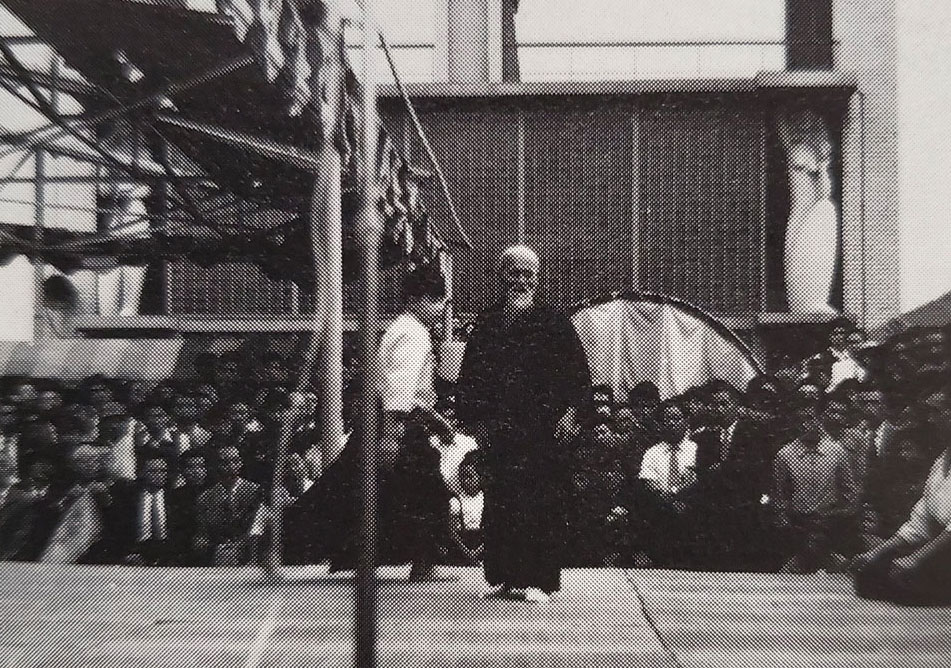 O Sensei during the first public demonstration held at Takashimaya in 1956.
For five days, the deshi succeed to each other to present the discipline and O Sensei ensures the final part of the demonstration. It is on this occasion that the classic format of aikido demonstrations is set and from then on, many other aikido teachers begin to organize their own demonstrations throughout Japan. Another important event is a class that takes place on the roof the Ministry of Defense in Akasaka, part which remain on film to this day.
- Ueshiba Kisshomaru demonstrating at the ministry of defense in 1957
The first edition of the All Japan Aikido Demonstration is held on May 5, 1960 at Yamano Hall in Shinjuku and it hosts nearly 150 experts. All these initiatives do much for the establishment of the reputation of aikido and they allow the return intensive activity at the Hombu Dojo. In the late 60s, aikido counts over 2,000 black belts.
- Ueshiba Morihei demonstrating at the ministry of defense in 1957
The Shihan Go Abroad
The first expert to demonstrate aikido abroad is Mochizuki MinoruMochizuki Minoru (望月 稔, 1907 - 2003) was a budoka 10th dan in aikido, 9th dan in jujutsu, 8th dan in iaido, 8th dan in judo, 8th dan in kobudo, 5th dan in kendo, 5th dan in karate and 5th dan in jojutsu. Mochizuki was one of the direct students of the founder of judo Kano Jigoro, the founder of aikido Ueshiba Morihei and the founder of Shotokan karate, Funakoshi Gichin. He spent eight years in Mongolia where he was an active educator and entrepreneur of projects to improve communications and irrigation. Mochizuki was the first to teach aikido in the West when he stayed in France from 1951 to 1953 as a judo teacher., a student of Kano Jigoro and Ueshiba Morihei who has moved to Europe to teach judo as well as other budo. Subsequently, Abe TadashiAbe Tadashi (阿 部正, 1926 - 1984) started aikido in Osaka in 1942 and continued to train directly under the founder in Iwama as an uchi deshi during WWII. In 1952, after obtaining his law degree from Waseda University, he moved to France where he studied law at the Sorbonne and taught aikido. He returned to Japan after seven years and became head of the international affairs department at the Hombu Dojo. moves to France in 1952 to study at the Sorbonne and he uses his spare time to teach aikido. Kisshomaru quickly encourages his own students to go abroad in order to establish aikido as official representatives of the Hombu Dojo. Tohei Koichi leaves for Hawaii in 1961 as the first Shihan officially sent abroad by the Aikikai. Then follow Tada Hiroshi, Yamaguchi Seigo, Noro MasamichiNoro Masamichi (野呂 昌道, 1935 - 2013) was an aikido teacher and the founder of Kinomichi. In 1955, while pursuing university studies, his uncle arranged for him to be introduced to Ueshiba Morihei, of whom Noro would become a disciple. He moved to France in 1961., Tamura Nobuyoshi, Yamada YoshimitsuYamada Yoshimitsu (山田 嘉光, 1938 - ) is an 8th dan aikido instructor. Originally from Tokyo, he became interested in aikido through his father's cousin, Tadashi Abe, who was a renowned instructor. He joined the Hombu Dojo as an uchi deshi in 1955 at the age of 17. His his ability to speak English made him a natural choice for teaching American soldiers. He moved to the United States in 1964 and became the chief instructor of the New York Aikikai and president of the United States Aikido Federation. , Asai KatsuakiAsai Katsuaki (浅井 勝昭, 1942 - ) is an 8th dan aikido instructor. Asai started training at the Hombu Dojo at the age of 13 and continued while studying at Meiji University. He was sent to Germany by Kisshomaru Ueshiba in 1965 to teach aikido. He currently runs a school in Düsseldorf., Chiba KazuoChiba Kazuo (千葉 和雄, 1940 - 2015) was an 8th dan teacher of aikido. Born near Tokyo, he practiced judo and Shotokan karate. In 1958, he was admitted as an uchi deshi at the Aikikai's Hombu dojo and began teaching in 1962. He lived in the United Kingdom and the United States, where he developed aikido considerably., and many others. Note that the majority of those who officially disseminate aikido abroad are students formed primarily under Ueshiba Kisshomaru in Tokyo.
It is not until 1963 that Kisshomaru himself begins to travel. His first official trip leads him to Hawaii, Los Angeles, and San Francisco over the course of a journey of about three months, an almost unbelievable experience for this former penniless salaryman. He is 43 years old and it is the first time that he gets on a plane. From this date and until the end of his life, he regularly travels around the world.
A prolific Author
Kisshomaru is a man of letters and culture, and his scholarship serves as a vehicle to expand the message of aikido. He complements his teaching on the tatami by some extensive editorial work. Kisshomaru is clearly the most comprehensive source of information available to us about both pre-and post-World War II eras and even though his sometimes criticized for his limited skills as a historian and some unavoidable biases, the careful study of his work is a must if one wants to better understand the development of aikido. He publishes his first book simply titled "Aikido" in 1957, and he will write about 20 more throughout his life.
 First edition of Kisshomaru's "Aikido" book published in 1957. This particular copy was signed by Kisshomaru and dedicated to "little"[sic] Tamura Nobuyoshi.
In 1959, the Aikikai starts the publication of the "Aikido Shinbun" [aikido newspaper], which is still being printed today. Kisshomaru writes a biography of Ueshiba Morihei in 1978. Kisshomaru knows more than anyone about the philosophy of his father, but he is also interested in geopolitics and science, he also regrets that what he considers to be his poor command of English does not allow him to better communicate with foreigners.
 A few Japanese and English editions of Kisshomaru's books.
Construction of the New Dojo
Given the incredible enthusiasm manifested by the public for aikido, it is clear that the 80-tatami space of the Kobukan has become far too narrow and it is decided to build a new structure to replace it. The old wooden dojo is destroyed and the land serves for the construction of the residence of the Ueshiba family. The new Hombu Dojo, a three-storey concrete building (an extension is added later) opens on January 2, 1968. It harbors a total area of more than 200 practice mats. The completion of that task earns Kisshomaru one of the very few explicit accolades from his father when he says, "You did well" the voice full of emotion. This building still serves as the world center of aikido today.
 Henry Kono and Alan Ruddock in front of the floor plan of the upcoming Hombu Dojo.
Death of Ueshiba Morihei
A few days before his death, Ueshiba Morihei calls his main students to his bedside and says:
Keep everyone together and support Kisshomaru.
He asks privately to Kisshomaru if he intends to continue after his death and when Kisshomaru responds yes, the old man is appeased. Ueshiba Morihei dies on April 26, 1969 and his succeeded by Kisshomaru as the second doshu of aikido. Kisshomaru keeps the world of aikido as unified as possible, even though some groups eventually split apart, which in Japanese martial arts is rather common whenever a patriarch dies. Morihei is known to have never kicked anyone out and Kisshomaru follows the same precept. This policy is also still valid under the direction of his son Moriteru and some organizations who have left the fold Aikikai have gradually been reinstated later.
 Ueshiba Kisshomaru and his son Ueshiba Moriteru.
International Development
The international development of aikido is such that establishing a structure to manage some aspects of practice abroad becomes necessary. The International Federation of Aikido is established in 1975 and Kisshomaru becomes its first lifetime president. The first international congress is held in Tokyo in 1976. In 1984, the number of practitioners worldwide reaches one million.
Aikikai Politics Under Ueshiba Kisshomaru
The main difficulty for Kisshomaru is to get the highly vertical Japanese iemoto system to work together with the more horizontal western system. The latter is problematic in his eyes, and he sees the vertical structure of aikido as an essential condition for the coherence of an art that is virtually free from competitions and awards. He is however willing to handle these differences in order to internationalize aikido. He therefore defines his mission in terms of the continuation in the footsteps of the founder, but he wants to do so within a structure that is adapted to the present day, with the overarching goal of bringing harmony between the East and the West.
The Tohei Case
Kisshomaru recognizes that if the discipline continues to grow, it is inevitable that contradictions appear. Obviously, despite the unification project of aikido, some breaks are inevitable. One of the most notorious is Koichi Tohei's resignation from the post of technical director of the Hombu Dojo. In addition to some personal issues between the two men, Kisshomaru thinks that Tohei puts too much emphasis on the ki in his curriculum, while he himself considers that ki should not be separated from aiki. If one puts this in context with Tohei's statement that the only thing he ever learned from Ueshiba Morihei was to relax, it helps better understand the irreconcilable difference of opinion between the two men. Faced with the refusal of Kisshomaru to modify the curriculum, Tohei leaves the Aikikai in 1974.
Ueshiba Kisshomaru's Aikido
Much has been written about this and the views held by those who did are generally rather strong. I will try to stick to the facts and most importantly, provide an explanation and context to the different choices that have been made.
We saw that Ueshiba Kisshomaru and his students are largely responsible for the dissemination of aikido after the war. Few prewar students of O Sensei have remained active and the majority of those who started post-war are actually students of Kisshomaru, Tohei, and Osawa rather than those of the founder. After the war, O Sensei travels extensively and when he steps on the tatami, it is often unannounced and mainly to talk about his philosophy. Therefore, it is largely Kisshomaru's vision and interpretation of his father's art that spreads through Japan and the world.
Although Kisshomaru accomplishes what he views as an extension of his father's work (and with the blessing of the latter), one must recognize the fact that social and political circumstances differ, and therefore, that the basic assumptions of father and son differ. Ueshiba Morihei taughtWhether Ueshiba Morihei ever made any effort to teach formally is a matter of some debate an art of war to a social and political elite within a culture of war. When Kisshomaru takes over, this belligerency has more or less disappeared from the spirit of the founderI will not elaborate here on the subject of the militaristic thinking Morihei but I encourage anyone to read Professor Goldsbury's column. and the Japanese capitulation has lead its people to strongly reject everything linked to its former expansionist regime, including its martial traditions and its shinto philosophy. In this context, Kisshomaru understands that aikido is relevant because of its message of universal harmony and he decides to mainly present it as a vehicle for that.
Kisshomaru's purpose is clearly to diffuse as widely as possible the humanist message that Ueshiba Morihei has adopted after the war. To critics who oppose him the argument of quality before quantity, he responds that the positive potential of aikido is such that the message ought to be spread widely, and that as long as people have access to instruction, there will always be a few who reach an exceptional technical level. On the other hand, he fears that if art remains confidential, it will eventually die out like many others before.
Kisshomaru is also keen to change the practice so that it remains relevant in the present day, which may be the largest bone of contention in the world of aikido. Yet, criticizing Kisshomaru on this basis is to disregard the fact that Morihei, in his time, did exactly the same thing regarding what his own master, Takeda Sokaku, had taught him. It is also interesting to note that if you talk to some practitioners of daito-ryu, you can hear exactly the same types of criticisms being expressed as those made against Kisshomaru, except that they are made against Morihei. Morihei has also changed his practice throughout his life, so much so that some of his pre-war students, including Mochizuki Minoru and Abe Tadashi, said that they no longer recognized themselves in the postwar aikido of the founder.
Let us also not forget that it is thanks to the choices made by Kisshomaru that most of us practice aikido today and that criticizing him on the basis of his open and broad diffusion of aikido is to deny ourselves any legitimacy to be practicing this art.
The Technique of Ueshiba Kisshomaru
It is sometimes said that Kisshomaru has been chosen as doshu for his administrative skills over his technical capabilities, but there is no evidence of this in the words of the founder. It is true that Kisshomaru is not the first choice of successor for Morihei, but one must keep in mind that when Morihei originally looks for a successor, Kisshomaru is only 11 years old and he does not formally practice aikido yet, which de facto the rules him out from the list of possible candidates.
When addressing the question of the influence of Kisshomaru on the curriculum of aikido, one should understand that the techniques of Ueshiba Morihei are at no point standardized and that most of them do not have standardized names. We know that most of the technical curriculum of aikido sprouts from that of daito-ryu, and interestingly, Takeda Tokimune, the son of Takeda Sokaku, also had to do a lot of work to standardize techniques and nomenclature in order to teach the art of his father to his own students a consistent way. Kisshomaru Ueshiba and some others such as Abe Tadashi also have to do the same for aikido.
 Extract from the educational work of Abe Tadashi and Jean Zin.
To put it bluntly, the number of aikidoka who have actually learned and mastered both so-called "modern" aikido, and the daito-ryu techniques of Morihei are very few and in my view, only those are able to offer a pertinent analysis of the changes that aikido has undergone. Others basically speak out of ignorance, provide no evidence to back up their claims, and should therefore be ignored.
According to Okumura ShingenobuOkumura Shingenobu (奥村 繁信, 1922 - 2008), was an 9th dan aikido instructor. Born in Hokkaido, he entered Kenkoku Univeristy in Manchuria in 1938, where he began training in aikibudo under Tomiki Kenji. He became part of the Aikikai Hombu Dojo teaching staff in the early 1950s and played a significant role in the post-war development of aikido., a pre-war student of Ueshiba Morihei, the three main contributions of Kisshomaru to aikido boil down to organizing, transmitting, and theorizing the art. Another interesting testimony, that of the great Shirata RinjiroShirata Rinjiro (白田 林二郎, 1912 - 1993) was a 9th dan aikido instructor. Born in Yamagata prefecture, he obtained 2nd dan in judo at the age of 17. He joined the Kobukan Dojo as an uchi deshi in 1933. He later traveled to Osaka with the O Sensei and remained there as a teacher., another prewar student of O Sensei and one of his favorites students, says of Kisshomaru that he "enhanced the techniques [of his father]".
Another element that should not be overlooked is a point that Kisshomaru makes himself when he says:
[...] However, people who saw my father's demonstrations before the war were known to say, "Morihei Ueshiba's techniques are certainly the work of a master, but this is a very difficult thing to duplicate – after all, perhaps they will be limited to Morihei Ueshiba himself.
It is clear that such as it is, the art can hardly be diffused. As a teacher, Kisshomaru understands that to transmit a body of knowledge, it is important to present it in a way that is coherent and understandable, and that is precisely what he sets out to do.
Regarding the form, until 1942, and even during a considerable period after that, father and son rigorously practice the same art. However, it is clear that later, Kisshomaru favors circular techniques. He even says that given that the character 丸 [maru] in his name means "circle", it is the symbol of what represents for him the essence of an aikido technique. Despite his long experience of the weapons of aikido, Kisshomaru chooses not to teach them in Tokyo in accordance to the will of his father who prefers that beginners practice taijutsu, and who considers that the Tokyo dojo is not appropriate for teaching weapons.
 Ueshiba Kisshomaru and Ueshiba Moriteru.
The Spirit of Aikido
We saw that Kisshomaru Ueshiba has clearly transformed aikido, starting off from an elitist discipline initially reserved for the military class, and shaping it into an activity of public interest. Resolutely turned towards the future, he believes that the golden age of aikido is in its development. From a personal point of view, he exhibits a humanist views and he writes rather extensively about it. This contrasts with the old budo that usually operate in terms of who is strong and who is weak. He explains that his purpose is beyond this, he wants to advance humanity.
On the other hand, the work of the historians of the discipline has shown that Ueshiba Morihei enjoyed, at some point, very cozy relationships with members of the Japanese ultranationalist circles and that it lasts at least until the middle of the war. The nature of the exact ideology of Morihei during this period is debatable, but it seems increasingly clear that he is not a pacifist and never becomes one. Kisshomaru insists on this repeatedly and adds that aikido is still a martial art and that therefore, it is not a pacifist system, even if the goal itself is to establish peaceTo clarify this point, I encourage the reader to look into the interview of Ueshiba Morihei that I annotated for Aikido Journal.. The maturation of aikido into something non-aggressive takes some time and it seems clear that the efforts and writings of Kisshomaru are the extension of the (late) change of heart of Morihei.
The Religion of Aikido
For the reasons explained above, in spite of being very educated on the subject, Kisshomaru removes most of the religious aspect of aikido, especially the kotodama, mainly due to the recuperation that was made of it by ultranationalists during the war, but also probably in order to give aikido a more universal and exportable dimension. In fact, O Sensei himself explains to Nocquet that it is not necessary to change one's religion in order to understand aikido. Unlike his father, Kisshomaru does not consider himself as a bridge between heaven and earth and has such, he never resort to the sort of rituals that Morihei is famous for. Kisshomaru is a pragmatic and rational man who admits he does not necessarily believe in the same things as his father, and he even goes as far as mentioning the works of great scientists and sceptics in his books when attempting to explain the Japanese concept of ki in the light of current scientific knowledge. He also adopts a rather rational point of view in his biography of Ueshiba Morihei, in particular when he goes out of his way to debunk a number of wild stories that have been circulating. From a moral point of view, the work of Kisshomaru is in line with the post-war thinking of O Sensei. It underlines in particular the importance of the homophony between 爱 [ai : love] and the 合 [ai : unification, rally] character found in the name of the discipline, which explains the introduction of the concept of love in the system of Ueshiba.
End of Life
Throughout his life, Ueshiba Kisshomaru receives many awards in Japan and abroad, including, on March 29, 1987, the Zui Hosho Medal of the Japanese government, which distinguishes individuals who have made significant contribution for the public interest and education. His health starts declining from 1979 and he leaves most domestic and international responsibilities to his son, Moriteru. He is admitted to the hospital in December 1998 and dies on January 4, 1999 at the age of 77 of respiratory failure. The funeral ceremony is held on January 7, followed by a public service at the Aoyama Funeral Hall on January 17, 1999. He leaves behind him a population 1.2 million practitioners.
 Commemorative plaque at the Hombu Dojo.
Epilogue
When I started aikido, I must say that I did not hear only good things about Ueshiba Kisshomaru. People used to say that he was far from exhibiting the talent of his father, that he was in fact more of an administrator, or that he even had misrepresented the discipline of his father. Yet, it is an undeniable fact that most people who have told me this are themselves the students of people who have been taught mainly by Kisshomaru rather than Morihei. It was only later, when I moved to Japan, and got to meet actual former students of Kisshomaru, that I realized the tremendous amount of respect that practitioners who had known the second doshu of aikido held for him. I think that anyone who knows a bit about the history of aikido and its dissemination cannot but feel the same deep respect and gratitude towards Kisshomaru and his work, and this, whatever the affiliation or technical preferences. I hope this article helps a bit with that.
Note: I am very much indebted to Mr Stanley Pranin and Pr. Peter Goldsbury for the incredible work they have produced over the years and without which I could not have written this biography. I would also like to sincerely thank them for providing me with helpful comments whenever I have a question.
