

André Nocquet was a man of both sword and pen. A former resistance fighter and a pioneer of martial arts, he was also one of the first foreign students of Ueshiba Morihei and the very first to have lived under the roof of the Ueshiba family. With this unequaled experience, he has greatly contributed to the development of Aikido, both in Japan and Europe. Having started aikido in Nocquet's group a few years before he passed away, I have spent a great deal of time gathering information about him and his pioneering trip to Japan. In fact, Nocquet's life has been a source of inspiration for my own relocation on the archipelago. I translated some previously unpublished articles of Master Nocquet, edited some videos from his personal archives filmed during his stay in Japan, and presented some newspaper articles that were published during his time in Japan. All of this work is published on this website and therefore, it seemed necessary to supplement these documents with a full biography of the man, especially given the fact that his life before Japan is at least as extraordinary as his pioneering journey in the world of aikido. Unfortunately, the sources documenting his early life are scarce and sometimes contradictory. This article introduces the elements that I thought were the most accurate. I would like to sincerely thank Mr. Michel Nocquet, the son of André Nocquet, who kindly accepted to review this article in order to prevent inconsistencies and inaccuracies. Many thanks also to Tada Hiroshi Shihan and Kobayashi Yasuo Shihan for providing me with a number of documents that had never been published before and for helping me add precision to some of the elements and events cited. Thank you also to Mr Frank de Craene, Claude Duchesnes, and Michel Desroches for providing me with documents from Noquet's archives, including his personal diary.
Youth in France and discovery of martial arts
André Auguste Nocquet was born on 30 July 1914 in Prahecq, in the Deux-Sèvres department of France. He was raised in a family of pig breeders who taught him to appreciate the value of simple things.
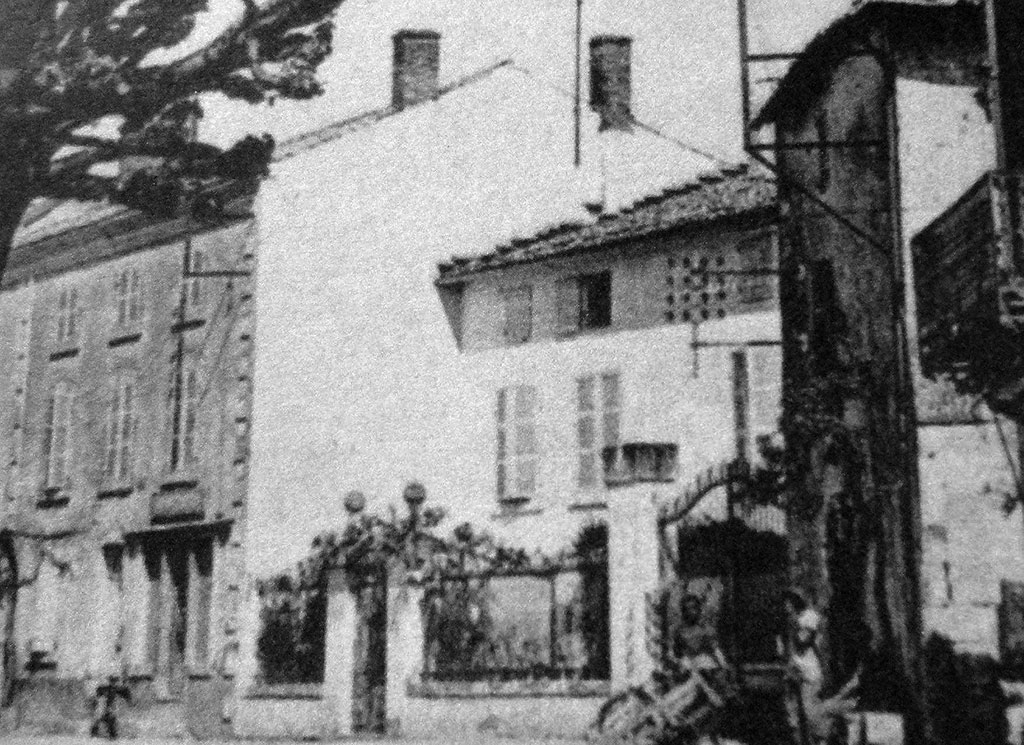 The Nocquet family house in Prahec.
It is in Niort, a dozen kilometers from the family farm, that he began his studies, before moving on to the National School of Non-Commissioned Officers (ENSOA) in Saint-Maixent. In 1929, while at Saint-Maxent, he got the opportunity to learn a new and intriguing empty-handed defense system with Chief warrant officer Raffier. Raffier had indeed acquired some knowledge of jujutsu, a rather confidential martial art from Japan, and only a handful of Westerners knew about it due to the fact that at the time, Japan was under a fairly strict isolationist policy. This experience left a strong impression on the young Nocquet and it gave him the desire to learn more about this remote country and its awesome warfare techniques.
The young André’s passion for effort and body culture is partly explained by a desire to compensate for his relatively small stature. Already naturally stocky, he pushed early on his own physical limits via the practice of greco-roman wrestling. However, what formally put him on the path of bodybuilding was the unexpected discovery of a bodybuilding manual belonging to his father, himself an accomplished athlete. The book was written by German pioneer and founder of modern bodybuilding, Eugen Sandow. Just as he did for most things throughout his life, Nocquet fully dedicated himself to this passion and he integrated just as much of Sandow’s performance principles as his aesthetic sensibility, eventually carving himself a remarkable body.
 Nocquet in his early thirties
After some time, André Nocquet started to consider living off his passion and despite some initial reluctance from his father who wanted his son to take care of the family buriness, Nocquet decided to study to become a gymnastics teacher. Having managed to convince his parents, he left for Paris in 1932 to enroll at the Desbonnet school located at 55 rue de Ponthieu, near the Champs-Élysées. There, he attended the classes of Dr. Boris Dolto, the pioneer of modern physiotherapy. It is interesting to note that Edmund Desbonnet had contributed to the introduction in France of Edward William Barton-Wright’s bartitsu, an art strongly influenced by Japanese jujutsu. The Desbonnet school actually used to run formal jujutsu classes for a while and although these had been discontinued by the time Nocquet arrived rue Ponthieu, it is not unreasonable to think that he might have received some degree of instruction in jujutsu while he was there.
 Jujutsu class at Desbonnet school. Image published in Le Petit Parisien in December 1905.
Now formally qualified as a gymnastics instructor and as a physiotherapist, Nocquet left the French capital in 1936 and opened his own fitness and therapy practice in the city of Angoulême. However, martial arts were soon to take the center stage in his life and by 1937, he began to make frequent trips to Paris to study jujutsu under the direction of Dr. Moshe Feldenkrais, the founder of the Jiu-jitsu Club de France. Two years earlier, Feldenkrais had invited the famous Kawaishi MikinosukeKawaishi Mikinosuke (川石 酒造之助, 1899 - 1969) was a Japanese 7th dan master of judo. He led the development of judo in France, as well as in much of Europe. to come and settle in France in order to teach judo, and Nocquet became the 17th student of Kawaishi Sensei in 1938. Nocquet proved a brilliant student and he distinguished himself on the tatami both during training and during competitions. Unfortunately, the breaking out of the Second World War was soon to put an end to this adventure.
 André Nocquet with Kawaishi Mikinosuke. Demonstration held during the first edition of the European Judo Championship, which took place on December 5 and 6, 1951 at the Vélodrome d'Hiver in Paris in front of more than 10,000 spectators.
Period of the Second World War
Nocquet was incorporated at the beginning of World War II in the 404th Regiment of defense against aircraft, but he was soon taken prisoner on June 4, 1940, during the Battle of Dunkerque near Malo-les-Bains. He was transferred from prison to prison, suffering privations of all kinds, which seriously undermined his once glorious physical condition. After several failed escape attempts, he finally managed to flee from Cologne's Stalag VI-G on October 11, 1943, and returned to France under the pseudonym Jean Hervé, where he joined the French Forces of the Resistance. Once the war ended, he was formally recognized for his heroism and awarded the "Médaille des Évadés" (Escapees' Medal), as well as the "Croix du Combattant".
Post-war practice and discovery of Aikido
Back in the Southwest in 1945, Nocquet resumed his professional activities in Angoulême. On September 12th of that year, he became the 56th Judo black belt in the country upon promotion by Kawaishi, who also issued him a self-defense certificate. Nocquet also created the first judo club in the region, where he promoted nearly 40 black belts of his own. The police in Bordeaux quickly took an interest in this exceptional individual and they requested him to teach their instructors in judo and jujutsu.
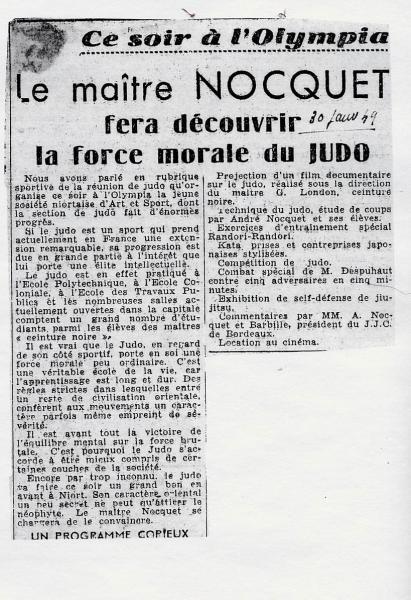 Excerpt from a French newspaper published on January 30, 1949, announcing the a demonstration of judo held by Nocquet.
It is in 1949, during his judo study, that Nocquet discovered a new discipline called aikido. He saw it being demonstrated by Mochizuki Minoru Mochizuki Minoru (望月 稔, 1907 --2003) was a budoka 10th dan in aikido, 9th dan in jujutsu, 8th dan in iaido, 8th dan in judo, 8th dan in kobudo, 5th dan in kendo, 5th dan in karate and 5th dan in jojutsu. who had been invited to France by Kawaishi. The circularity, elegance, and refinement of Aikido techniques made a strong impression on Nocquet. Most importantly, the lack of grabs and pre-arranged positions made him realize that to defend himself in the street, a knowledge of the techniques of aikido could be very complementary to his skills in judo. He immediately decided to devote himself to learning this new discipline and he became a student of Master Mochizuki, effectively enrolling on the spot. The rather Cartesian approach of Mochizuki, which was the fruit of his efforts to turn traditional Japanese teaching into something more adapted to the Western audience, appealed very much to Nocquet and he studied with him with great dedication until Mochizuki left France in 1952.
- Budo demonstration performed during the first edition of the European Judo Championship (1951) in front of more than 10,000 spectators. Demonstrators include Kawaishi Mikinosuke, Shozo Awazu, Mochizuki Minoru, and André Nocquet. This is probably the first ever demonstration of Aikido in the West.
The charge of coordinating aikido in continental Europe was then assigned to Abe TadashiAbe Tadashi (阿部 正, 1926 - 1984) started aikido in Osaka in 1942 and continued to train directly under the art founder in Iwama as an uchi deshi during WWII. In 1952, after obtaining his law degree from Waseda University, he moved to France where he studied law at the Sorbonne and taught aikido as a 6th dan representative of the Aikikai Honbu. He returned to Japan after seven years and became head of the international affairs department at the Hombu Dojo.. His Aikido seemed even more impressive to Nocquet, albeit a little edgier, and perhaps violent. Nocquet continued his study of Aikido under Abe, who promoted him to the rank of first Dan in 1954. Nocquet now 4th dan in Judo and an Aikido 1st dan, founded clubs in the cities of Bordeaux and Biarritz, where he taught until 1955, ensuring the promotion of over 200 black belts.
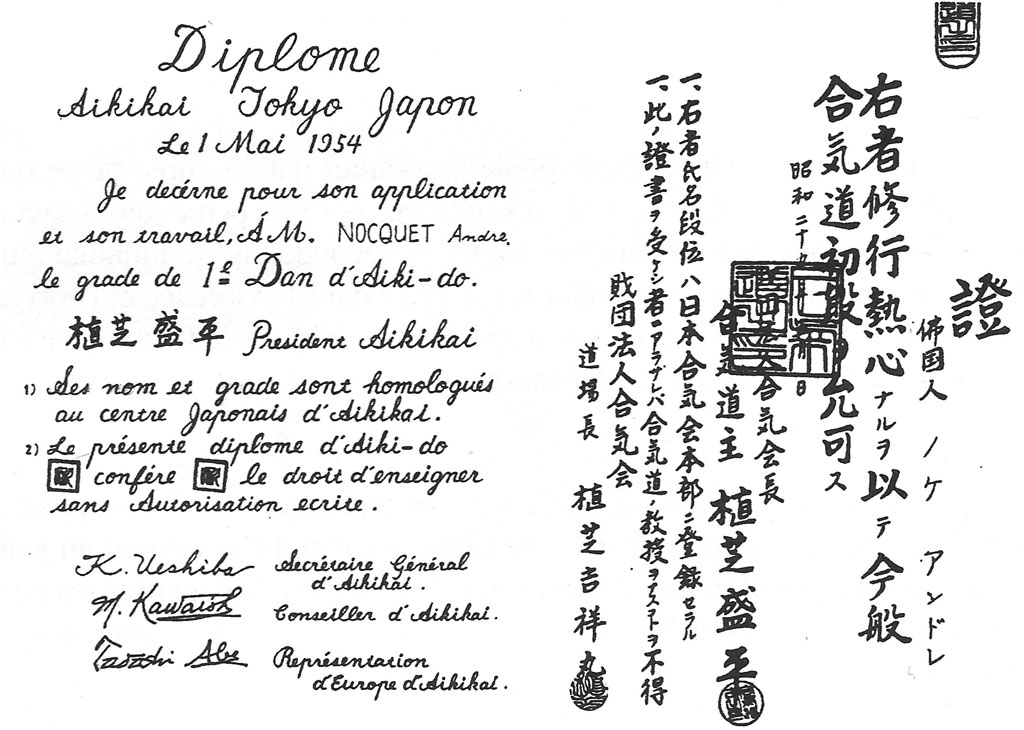 Nocquet's first dan aikido diploma signed by Ueshiba Morihei. Note that Kawaishi serves as an advisor to the Aikikai.
Seeing his unusual enthusiasm and aware of his abilities, Abe advised Nocquet to go to Japan to learn aikido at the source. Nocquet, who was then running a large dojo in Bordeaux with over 300 students, took some be convincing, but after a few months, and following the agreement of the Kodokaa to send Michigami HakuMichigami Haku (道上 伯, 1912 - 2002) was a 7th dan Kodokan judoka from Ehime Prefecture. to replace him, Nocquet finally agreed to make the trip. Under the supervision of the French Ministry of Cultural Affairs and the advice of the French academician Georges DuhamelGeorges Duhamel (1884 - 1966) was a French author, born in Paris. Duhamel trained as a doctor and during the First World War. In 1935, he was elected member of the French Academy. In 1953 he published the book “Japan between tradition and the future”., who was also a friend of the Nocquet family, André was put commissioned to travel to Japan in order to strengthen the bilateral relations established by the Franco-Japanese Cultural Agreement.
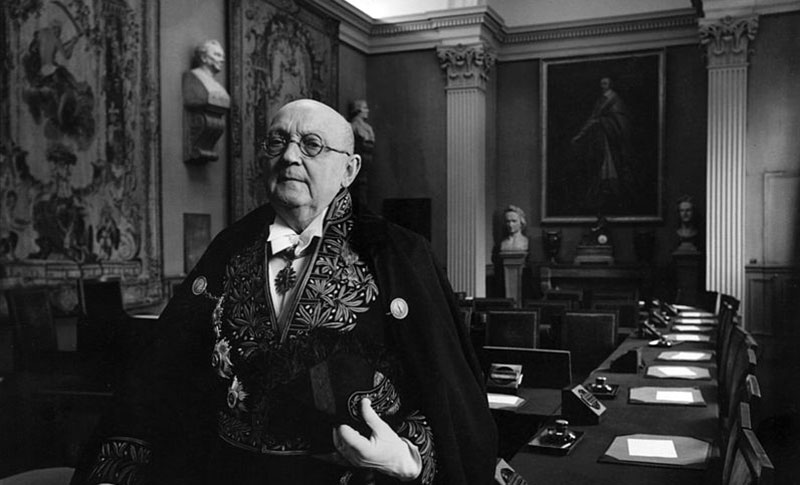 Georges Duhamel
Duhamel, who had repeatedly traveled to Japan, assumed the role of a mentor for Nocquet before his departure, warning him about the culture shock that was to come, and advising him to reach its destination by boat, since according to him, one had to earn Asia in small steps. Nocquet's mission would be to study aikido as the first foreign student to live at the home (uchi deshi) of the founder, Ueshiba Morihei. He was also mandated to learn little-known healing methods such as physical therapy, shiatsu, and seitaijutsu. The French newspaper "Sud-Ouest" also asked Nocquet to serve as a correspondent in Japan.
Departure for Japan
Nocquet left for Japan in June 1955, at the age of 40. Following the advice of Duhamel, he took the boat, travelling in fourth class on the maritime mail ship "Le Laos". He killed time during the crossing by teaching jujutsu to the ship's officers, who in turn, gave him access to a first class cabin when it got too hot.
 The merchant ship "Laos"
Nocquet arrived in Japan after a month of crossing. The photograph taken when he arrived shows that Ueshiba KisshomaruKisshomaru Ueshiba (植芝 吉祥丸, 1921 - 1999) is the son of Ueshiba Morihei, the founder of aikido. He took the helm of aikido after the death of his father. To learn more, read a full biography of Ueshiba Kisshomaru., Sunadomari FukikoSunadomari Fukiko (砂泊扶 妃子, 1914 - 2006) was Sunadomari Kanshu's older sister. She lived at the Hombu Dojo and was a close confidante of the founder until his death. She was also a high-ranking naginata practitioner., and a young Tamura Nobuyoshi Nobuyoshi Tamura (田村 信 喜, 1933 - 2010) entered the Aikikai Hombu Dojo in 1953 as an uchi deshi. He moved to France in 1964 and became one of the driving forces behind the development of aikido in Europe. wearing his student uniform, were part of his welcoming committee. We also note the presence of Yamada IchiroYamada Ichiro (山田 一郎) was a Buddhist teacher and monk in Kyogakuin (京学). and his two daughters, the French-speaking painter Narui KouNarui Kou (成井 弘, 1910 - 1990), is a Japanese artist who graduated from the Tokyo Art School in 1937. He began to paint seriously after the war and helped found the Nikikai (二紀会) in 1947. He moved to France in 1952 and under the advice of Tsuguharu Fujita (藤田 嗣治). Returning to Japan, he became permanent director of the Nikikai in 1967. He often traveled to Europe and the Middle East, paintings landscapes in various places he visited., as well as the brother of Michigami Haku who sent this very photograph to his brother in France.
 Nocquet's arrival in Yokohama in 1955.
Upon his arrival, Nocquet was invited at the Ministry of Foreign Affairs, where he was officially welcomed by Mr. Kuninosuke Matsuo Kuninosuke Matsuo (松尾 邦之助, 1899 - 1975) is a Japanese journalist, critic and translator. He lived for a long time in Paris until the German occupation in 1940. He then greatly contributed to cultural exchanges between Japan and France., the deputy editor of the Yomiuri newspaper. Nocquet did not speak any Japanese, but he had relatively good command of English, which allowed him to find his feet quickly. He would also rely from time to time on the support of His Excellency Sato NaotakeSato Naotake (佐藤 尚武, 1882 - 1971) is a Japanese diplomat and politician. After serving as Mukden's Consul General and Executive Secretary of the London Naval Treaty, he became Imperial Japanese Ambassador to Belgium in 1930, then to France in 1933. of the United Nations League, and of the French-speaking philosopher Tsuda Itsuo Tsuda Itsuo (津田 逸夫, 1914 - 1984) was a Japanese philosopher and practitioner of aikido and seitai. He left for France in 1934, where he studied with Marcel Granet and Marcel Mauss until 1940, when he returned to Japan. He studied noh and seitai there. Piqued by Ueshiba Morihei and his extraordinary techniques, he also began to study aikido after André Nocquet left, around 1961. In 1970, he returned to Paris and lived there until his death in 1984.. Nocquet was very surprised to learn that his hosts knew nothing about aikido, which was understandable since until recently, Ueshiba only taught small circles of students from the upper strata of Japanese society.
The daily routine at the Aikikai Hombu Dojo
André Nocquet wa eventually taken to the Hombu Dojo in Ushigome, where he would live with Ueshiba Kisshomaru and his wife, Sakuko. The family would do their best to adapt to the needs of French despite the family's limited budget. The living and training conditions are very difficult for him and he finds it quite difficult to sleep on the floor of the small room with three tatami mats. He also develops giant urticaria several times in reaction to the unusual diet.
 André Nocquet with Ueshiba Sakuko and Sunadomari Fukiko (right).
Despite the care of his hosts, Nocquet felt quite lonely. Few people in the Hombu Dojo spoke a language other than Japanese, and communication was a bit difficult. Even though Tsuda Itsuo was sporadically present to translate O Sensei's words for Nocquet, he was not with him on a daily basis. It should also be noted that besides the fact that he was the only foreigner, at age 40, he was also older than most of the people of Hombu, including Ueshiba Kisshomaru himself.
 Nocquet with the deshi of the Hombu Dojo. Among those present on the picture are Kobayashi Yasuo, Yamada Yoshimitsu, Tamura Nobuyoshi, Noro Masamichi, and Asai Katsuaki.
This relative isolation was not broken until 1956 when Tohei Koichi Tohei Koichi (藤平 光一, 1920 - 2011) was a 10th dan aikidoka and the creator of ki-aikido. From 1953, Koichi Tohei Sensei began introducing aikido to the West, mainly through regular teaching trips to Hawaii, but also to the continental United States and Europe. returned to Japan after spending a year in the United States. Tohei is therefore probably the only Hombu instructor able to communicate in English with Nocquet at the time. Interestingly, Nocquet didn't begin writing a practice journal until then, almost a year after arriving in Japan.
 Nocquet with Tohei Koichi at the Hombu Dojo
The teaching style was very different from what he is used to. While Mochizuki Minoru and Abe Tadashi had taken a very systematic and pedagogical approach to teaching, at Hombu Dojo it was all about repeating the same movement, without explanation, until exhaustion. During a discussion I had with Isoyama Hiroshi Shihan, he told me that Nocquet had encountered some technical difficulties and that a major technical overall was necessary. He said that he found it remarkable that an older man as experienced as Nocquet took it upon himself to start from scratch.
- André Nocquet practicing with Tamura Nobuyoshi at the Aikikai under the direction of Ueshiba Morihei
Later, André Nocquet would often say that the uchi deshi Tamura Nobuyoshi and Noro Masamichi quickly became his favorite partners, even though the practice was sometimes quite physical. He trained them and the 20 or so other regular students for five hours each day. Some documents suggest that other students also lived in the dojo. In a letter that she wrote to Nocquet's family on November 30, 1955, Sunadomari Fukiko mentions that she too lived in the dojo and trained with Nocquet.
 Letter written by Sunadomari Fukiko to Nocquet's family.
Every day, the same routine was followed. André Nocquet got up at five o'clock and started cleaning the dojo for one hour, followed by a first hour of practice at six o'clock, then a second, after a half an hour break. Ueshiba Kisshomaru ran the majority of early morning classes, although advanced students like Tada Hiroshi, who was already 4th dan at the time, also contributed.
 Excerpt from the Journal of André Nocquet for August 28, 1956 showing the importance of Ueshiba Kisshomaru. "In Wakamatsu-Cho, O Sensei and Waka Sensei who are the true heirs of all Aiki-Do techniques now teach instructors such as: TADA, YAMAGUCHI, OKUMURA, OSAWA, TAMURA, NORO, genSAN [sic], ARIKAWA, etc. These train each day following the precious teachings given by the revered Master O Sensei to his son. And Waka Sensei [Ueshiba Kisshomaru] teaches every day with his heart and his righteousness to of all his pupils, whatever their nationality."
O Sensei also taught, but on an ad hoc and impromptu basis, whenever he was in Tokyo. Breakfast came only after the second class, and while the craving for food is intense, Nocquet admitted that he never really got used to eating marinated fish for breakfast. This snack was followed by a free practice until lunch time, which was prepared for the uchi deshi by Kisshomaru's wife.
 Nocquet receiving a technique from Ueshiba Kisshomaru under the eyes of O Sensei
The few other foreigners who attended the Hombu Dojo were mostly Americans who did not live in the dojo and who came only occasionally. The dojo had effectively just resumed operations after General MacArthur’s ban on martial arts was lifted through the 1951 Treaty of San Francisco.
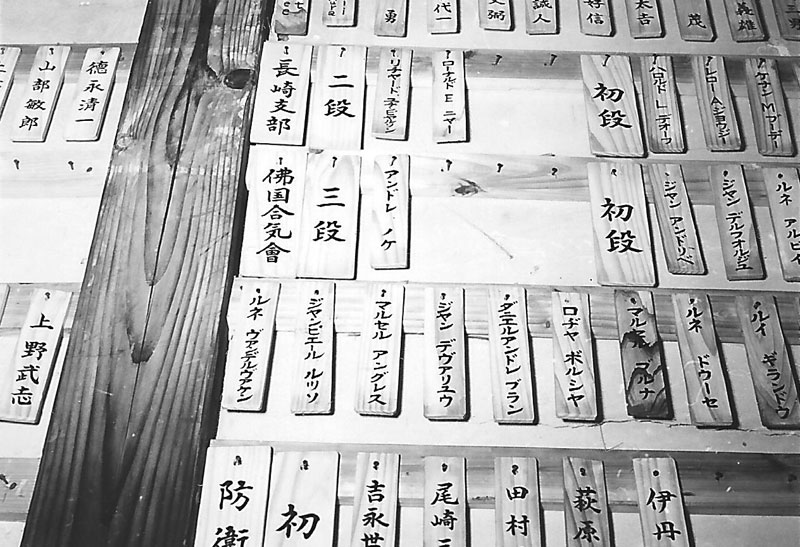 The Hombu Dojo nafudakake showing the names of students abroad (Nocquet is the only French third dan)
Meals were occasions to speak more freely with Ueshiba Morihei, even though André Nocquet constantly needed the support of interpreters. At 4:00 p.m., training resumed under the direction of dojo instructors such as Koichi Tohei, then Aikikai Technical Director, Okumura Shigenobu, Osawa Kisaburo, and Tada Hiroshi. The class was followed by a 30 minute break until 5 p.m., and finally, a final hour of practice to conclude the day.
 Tada Hiroshi, André Nocquet, and Yamaguchi Seigo in front of the Hombu Dojo
Clearly, of all the instructors, Nocquet received the most instruction from Ueshiba Kisshomaru and Tohei Koichi. This is evidenced by the fact that notes on Tohei's classes make up the bulk of the number of entries in Nocquet's diary, followed by those of Kisshomaru.
Mr. Tohei went from Hawaii to mainland America and probably because of that, he was good at explaining things in a simple manner. [...] It was easy to understand and he was good at explaining Ki also. I think that influenced Nocquet a lot.Kobayashi Yasuo - Interview with Kobayashi Yasuo
The beginnings of the international recognition of aikido
The Ueshiba family was not as wealthy as it once was, when aikido was taught mainly to members of the upper classes of Japanese society. Therefore, outside support would be required if the organization was to survive. According to Okumura Shigenobu, the arrival of Nocquet really marked a media upturn in the dojo with domestic and international journalists taking much interest in the extraordinary adventures of this middle-aged man.
 Yomiuri newspaper article about André Nocquet (kindly provided by Tada Hiroshi Shihan)
André Nocquet was therefore asked to use his contacts and set up an official event to present aikido to foreign dignitaries present in Japan. On September 28, 1955, O Sensei gave his first lecture at the Hombu Dojo on the spiritual aspects of aikido to cultural representatives from several embassies. The Department of Culture and Information of the Embassy of France subsequently sponsored a demonstration taking place at the Hombu Dojo on September 25, 1956 in the presence of the press and representatives of foreign embassies. During this event, O Sensei gave a lecture on the spiritual ideals of aikido, followed by a demonstration in which Nocquet participated.
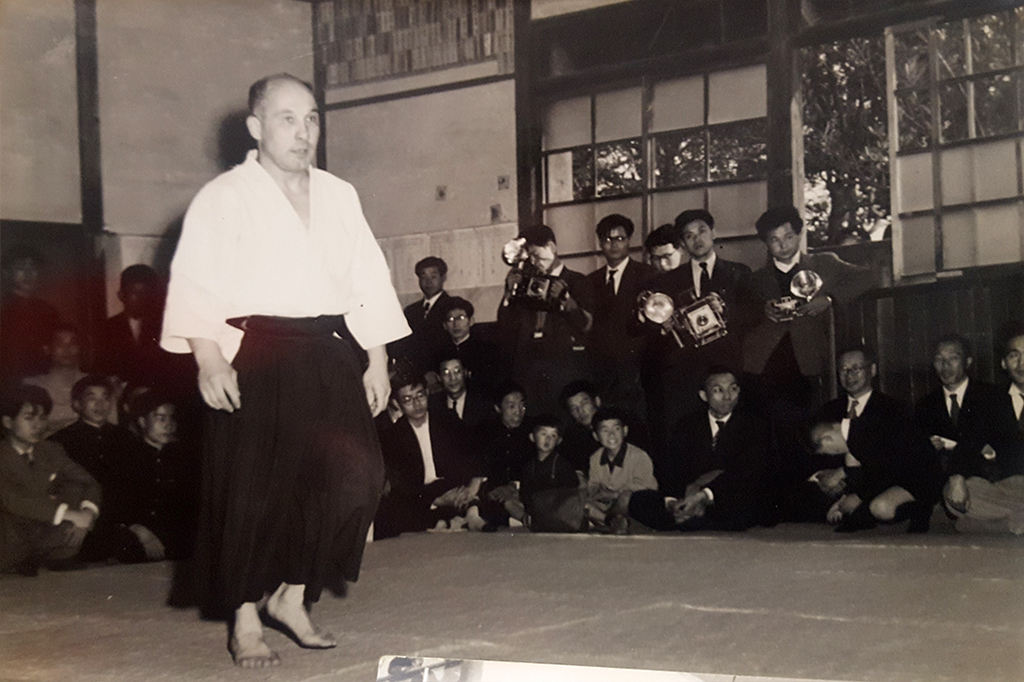 Nocquet demonstrating at the Hombu Dojo.
The event was a success and it had a reach that went far beyond Japan. This is, in fact, constituted the starting point of the incredible enthusiasm for aikido aboard. Further demonstrations followed, including those on the rooftops of several Tokyo department stores. Nocquet was already in Japan when the first public aikido demonstration was held on the roof of the Takashimaya department store in September 1955, but the extent of his involvement is uncertain. According to Kobayashi Yasuo, Nocquet, however, participated in a later demonstration organized by the Yomiuri newspaper on the roof of the Toyoko department store in Shibuya, which is were a great deal of the photos presented in his book "Maître Morihei Uyeshiba : Présence et message" were taken.
 Demonstration on the roof of the Toyoko department store in Shibuya in 1957 (the photo is dedicated by Nocquet to Kobayashi Yasuo Shihan, who kindly allowed me to reproduce it here).
Nocquet spoke a number of times to the foreign press and politics, including a speech that he gave on Remembrance Day on the 11th of November 1956, which is transcribed in his diary. According to another entry in Nocquet's personal journal, some work to shoot a promotional video had been initiated, including a section shot in the garden of the Hotel Chinzanso Tokyo.
 Extract from André Nocquet's personal diary (dated November 1956)
I found excerpts corresponding to the description in the diary when I browsed into Nocquet's archives. It is Tada Hiroshi Shihan who put me on the right path one day we were watching those films, when he told me that the place we were looking at was the Chinzanso garden. However, unlike what the diary suggests, these films are in height millimeters black and white, and not sixteen millimeters color. I don't know if the project was ever finalized, nor if it was released.
- The founder of Aikido Ueshiba Morihei is seen taking a walk with his son, the second Doshu Ueshiba Kisshomaru, André Nocquet, and a number of unidentified persons. The woman on the right of O Sensei at 2:10 is Sunadomari Fukiko, the elder sister of Sunadomari Kanshu, and a close personal confidante of the founder until his death. She was also a high ranking practitioner of aikido.
Other martial experiences and official recognition
In his spare time, Nocquet studied self-defense with Tomiki Kenji, the head instructor at judo headquarters, the Kodokan, who would go on to found the style of aikido that bears his name. I also found photos in Nocquet's archives where he appears training under the direction of Takimoto Tekko, the founder of Takimoto-ha Fusen-ryu jujutsu. Fusen-ryu jujutsu is a relatively recent (early 19th century) koryu known for its bare-handed jujutsu techniques, especially its groundwork and study of atemi. A certain rivalry between Fusen-ryu and the Kodokan of Kano Jigoro seem to have existed and a theory circulates according to which Kano Jigoro decided to add newaza to his judo following a defeat by his students at the hands of representatives of Fusen-ryu.
 André Nocquet with Takimoto Tekko and his students.
On the subject of judo, André Nocquet obviously established some contacts with Japanese judoka. For instance, he even seems to have met his own teacher's teacher, Kurihara TamioKurihara Tamio (栗原 民雄, 1896 - 1979) was a famous 10th dan judoka who was among others, the teacher of Kawaishi Mikinosuke. He was the head teacher at a vocational martial arts school, as well as an instructor for the Kyoto Prefecture Police. A postcard sent by Nocquet to Michigami Haku suggests that he made a trip to Kyoto to visit Kurihara at the end of 1956.
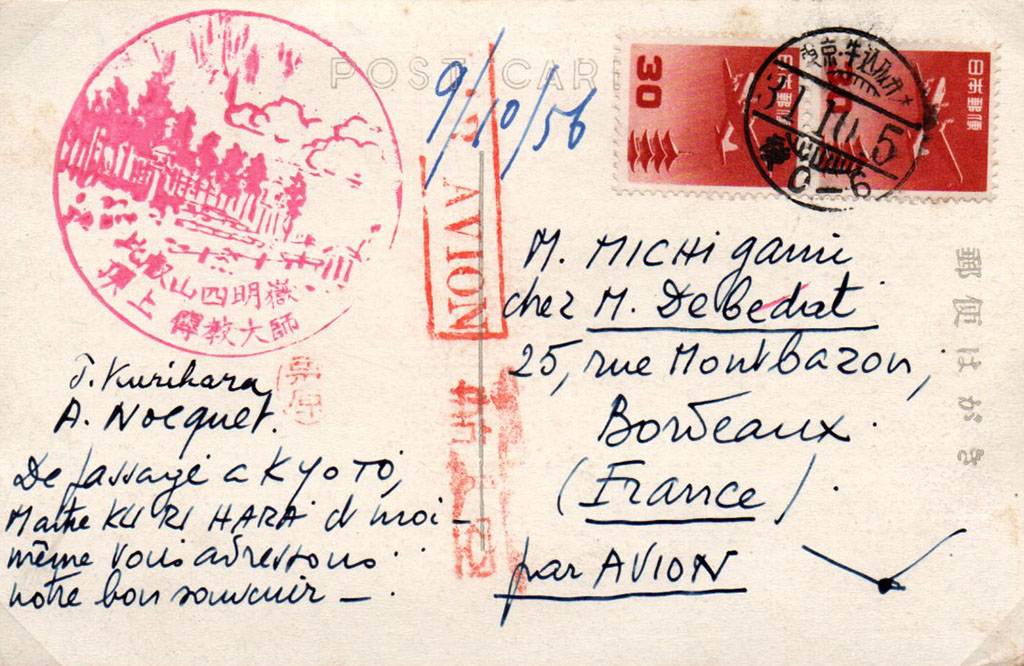 Postcard written by Nocquet to Michigami in 1956.
In his diary, Nocquet also mentions classes that he took at the Tempukai with Tohei Koichi under the direction of Nakamura Tempu, the founder of Japanese yoga, and whose influence on aikido instructors of that time is very important. He also appears to have been studying kempo under the guidance of a Mr. Savoy, whom I have not been able to identify. Nocquet also briefly studied Kyokushin karate with its founder, Oyama MasutatsuOyama Masutatsu (大山 倍達, 1923 - 1994) is the founder of Kyokushin karate, which is considered the first and most influential style of full contact karate. Born in a Zainichi Korean family, he spent most of his life in Japan and acquired Japanese nationality in 1968.. According to archaeologist Jay Gluck, a contemporary of Nocquet, the latter even performed ascetic training in the mountains during the winter with Oyama.
Mas took mountain training at least once every winter. One year he took along a sparring partner, André Nocquet, French savate expert and holder of a high-rank blackbelt in judo, who had been sent to Japan by the French national judo organization to study karate, aikido, and Chinese kempo. [...] André said Mas had them out barefoot in the snow. Before dawn every morning they did an hour of exercise and freestyle karate-savate-judo and anything-goes grappling. “Then,” says André, “we’d eat a breakfast for a medieval monk and spend the rest of the morning yelling poetry at each other, me in French, Mas in Korean or Japanese, before our midday workout and hermit’s lunch.”On Writing Zen Combat by Jay Gluck
Nocquet would also take up some of these ideas later and he would sometimes lead training in the snow with his European students.
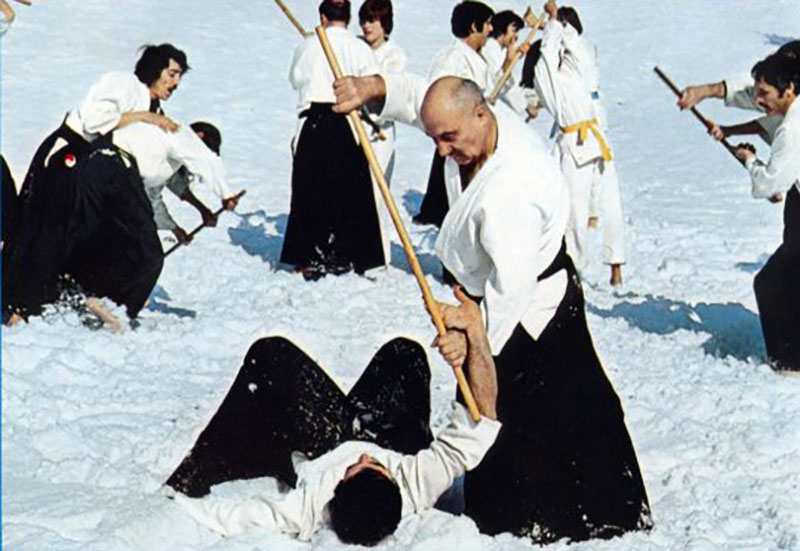 Nocquet teaching a class in the snow.
However, he was soon scolded by Ueshiba, who told him that he had come to concentrate on aikido. He therefore stopped his training with Oyama, the latter understanding very well that the simultaneous practice of these two demanding disciplines was not realistic. It is interesting to note that Nocquet later wrote in his diary the following:
Several students are studying aiki, karate, kempo at the same time to defend themselves, what do they understand about the spirit of aiki? [...] The practitioner of aiki cannot practice other arts of self-defense if he understands the spirit of aiki well. Otherwise, by practicing others he proves that he has understood absolutely nothing.Extract from the personal diary of André Nocquet dated September 12, 1956
André Nocquet, whose mission was also to study Japanese health systems, also received a diploma in shiatsu from Namikoshi Tokujiro Namikoshi Tokujiro (浪越 徳治郎, 1905 - 2000) is the founder of shiatsu therapy and the president of the Tokyo International Shiatsu School.. This diploma is dated December 25, 1955, less than six months after Nocquet's arrival in Japan, and we can therefore assume that this is a title reflecting a relatively superficial level of knowledge. It should also be noted that Nocquet received the elementary level diploma just two weeks before, which suggests that Nocquet was taking part in an intensive internship.
 Intermediate level shiatsu diploma awarded on December 25, 1955 to André Nocquet by Namikoshi Tokujiro.
Nocquet was also requested by Nishi KatsuoNishi Katsuzo (西 勝造, 1884 - 1959) was the founder of Nishi Shiki in 1927. He also worked as chief engineer of Japan's first metro project and was an aikido teacher at the Hombu Dojo, and his “goldfish” (kingyo undo) exercise is still performed during warm-ups today. to teach the principles of Japanese health systems to French officials. Nishi was also an instructor at Hombu Dojo, and his "goldfish" (kingyo undo) exercise is still performed during warm-ups today. Nocquet is believed to have submitted a report to the French Academy about Japanese healing techniques, but I was unable to locate a copy.
 André Nocquet at the Hombu Dojo with Ueshiba Morihei and Namikoshi Tokujiro (right)
In 1957, shortly before he departure, Nocquet was officially promoted to the rank of shidoin (instructor) of the Aikikai Hombu Dojo and he also received a diploma in self-defense from Tomiki Sensei.
 Nocquet's Shidoin certificate (signed by the Dojo-cho Ueshiba Kisshomaru 14th October 1957)
Departure from Japan and return to France
Nocquet left Japan via the port of Yokohama in October 1957. On this occasion, a large number of people, including Ueshiba Kisshomaru, Tada Hiroshi, Sunadomari Fukiko, Kobayashi Yasuo and many other students and instructors of the Hombu Dojo accompanied him to wish him a safe return.
 Nocquet about to leave Japan from the port of Yokohama. On Nocquet's right are Tada Hiroshi and Ueshiba Kisshomaru and further on the right is Nishio Shoji.
Nocquet stopped over in the United States and taught aikido with the Fresno City Police Department. He received a certificate from the National Exchange Club of the United States on February 11, 1958. Robert Cornman, an American student from Nocquet, contacted the Fresno Police Department on my behalf but unfortunately there does not seem to be any evidence or witness left. Fortunately, there subsists a letter from the National Exchange Club written by Dean Mell and Harry Thomason, where they thank Nocquet for demonstrating self-defense on the two TV stations of the area. Mell was Fresno's first TV News anchor and he had a long career in broadcasting until his passing in 2017. The letter mentions that Nocquet demonstrated with the help of a male assistant called Lindy Avakian. Lindy Vahag Avakian (1927-2003) was the author of several books, including two on judo written in the late 1950's.
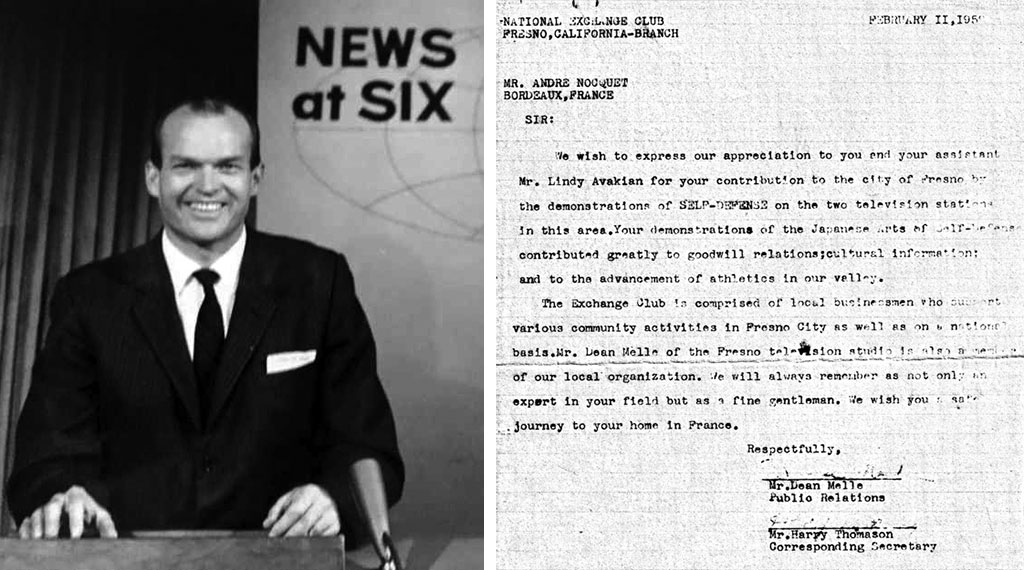 Left: Fresno's first TV News anchor Dean Mell (1928 - 2017). Left: Letter written to Nocquet by Dean Mell and Harry Thomson on behalf of the National Exchange Club.
The circumstances in which Nocquet taught there remain unknown thus far, however. Nocquet finally returned to France in the summer of 1958.
 Nocquet departing from the port of Yokohama (photo kindly provided by Kobayashi Yasuo Shihan)
Upon his return to France, André Nocquet immediately began teaching. He was also asked to write a lengthy report for the Ministry of Education, comparing what he had learned in Japan with traditional European martial techniques since the 15th century.
Official duties as a representative of the Aikikai and management of aikido in France and Europe
Abe Tadashi promoted Nocquet to the rank of 4th dan on December 10, 1959. When Abe returned to Japan in 1960, he appointed Nocquet as his successor in his functions for the development of aikido in Europe and presented him to European practitioners via a letter written on Friday, May 20, 1960.
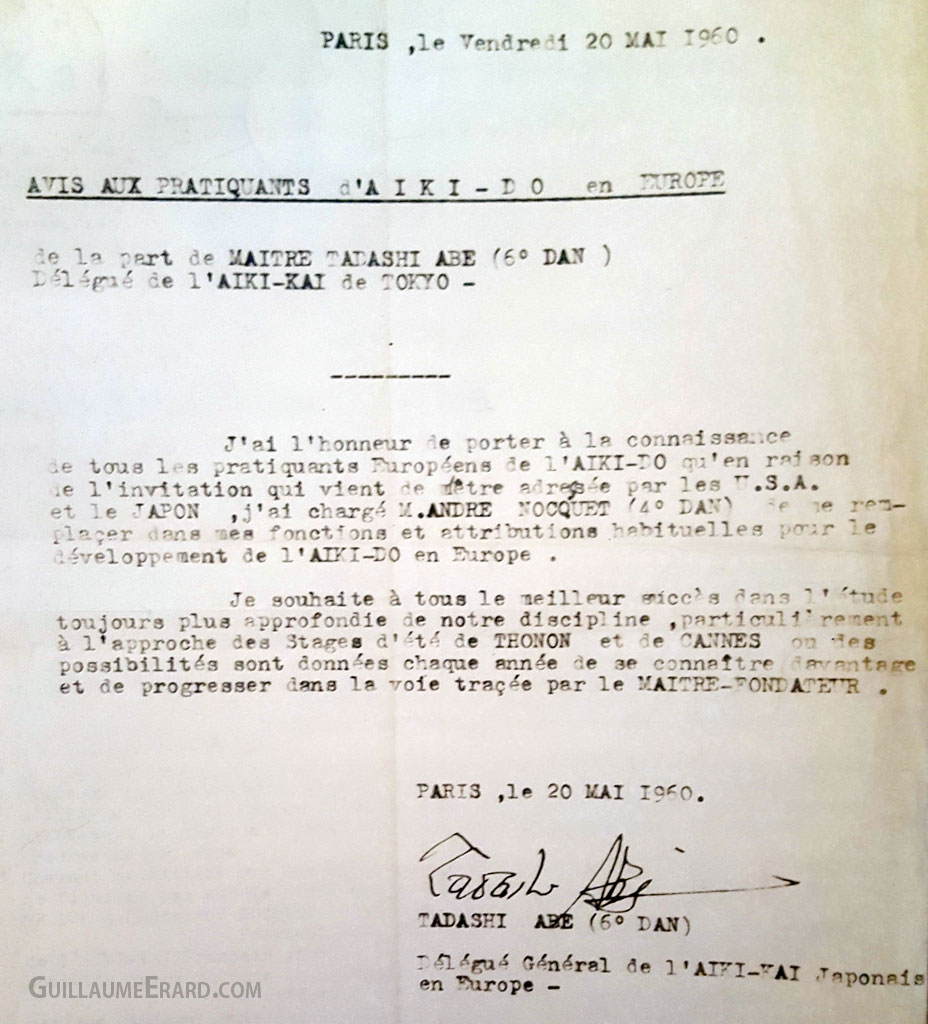 Letter from Abe Tadashi presenting Nocquet as his successor.
This function, and Nocquet's right to award dan ranks, was confirmed by Murashige Aritomo, who was a 9th dan and the General Aikikai Delegate for Europe via a letter sent on July 8, 1962.
 Letter from Murashige Aritomo confirming the role of Nocquet in France.
Ueshiba Kisshomaru commissioned Nocquet to welcome the arrival in France in 1961 of fellow uchi deshi Noro Masamichi. He suggests in his letter that Nocquet will receive a promotion, but its nature is not specified. The same year, Nakazono Mutsuro who would arrive to France from Singapore, then later in 1964, Tamura Nobuyoshi. The three men were sent to help develop aikido in France and the rest of Europe.
 Letter from Ueshiba Kisshomaru announcing the arrival of Noro Masamichi. Note the function of Abe Tadashi, who despite the legend surrounding his departure from the Aikikai, suggests that he remained, at least for a time after his return to Japan, an employee of the organization.
The promotion described above coincides with the fact that Ueshiba Morihei awarded Nocquet a 5th dan title on April 12, 1962 via Murashige. Unfortunately, I have not found the original of the diploma but a certified translation is available in the book by Jean-Daniel Cauhépé.
 Official translations of two documents issued by Ueshiba Morihei. Left: Awarding of the 5th dan Aikido to André Nocquet. Right: Promotion to the function of General Representative of the Aikikai for France.
The presence in the territory of so many high-level instructors exacerbated tensions within an already heterogeneous aikidoka community, and leads to the splits and differences of opinion that are still alive today.
There were territorial disputes, such as one opening a dojo, and another opening one nearby. […] But yes, they were fighting for territories like that, but I couldn't say which one was at fault.Kobayashi Yasuo - Interview with Kobayashi Yasuo
One of the main sources of discontent on the part of Aikikai is believed to be that Nocquet had decided that aikido should join the judo federation.
 Letter from Abe Tadashi to Nocquet from 1964 criticizing his decision to join the judo federation.
It seems that Kobayashi Hirokazu was sent to Europe to learn more about the issue and as a rsult of his investigations, he wrote the following letter to Nocquet a little later, hence rehabilitating him:
 Letter from Kobayashi Hirokazu to Nocquet dating from 1965.
The conflict between Nocquet and the Aikikai lead to a lawsuit brought in France by Nocquet against the Aikikai, with probable origin the financial arrangement previously established between Nocquet and Abe Tadashi with regard to the transmission of the task of representative for France and Switzerland. The 1971 Cour de Cassation ruling specifying this arrangement and proving in favor of Nocquet is available here. This unfortunate event would have resulted in Nocquet's dismissal from Aikikai and the removal of his titles.
[…] On December 10, 1959, two agreements were signed between Nocquet and Abe, who qualified himself as the master's delegate general for Europe… for the development of Aikido in Europe;That under these agreements, Abe granted Nocquet, for thirty years, the exclusive right to teach aikido in Paris and in the Paris region and gave him the right to confer certain ranks on his students;
That in return, Nocquet paid Abe a sum of one million old francs, it being agreed that in the event that Abe designated another representative in place of Nocquet, the latter would be entitled to reimbursement of the aforementioned sum;
That Nocquet, arguing that Abe and the aikido delegates had broken these commitments, sued Abe and the World Aikido Center for reimbursement and damages; [...]Extract from the judgment of the Court of Cassation, Civil Chamber 1, of June 9, 1971, 70-11.408. Published in the official bulletin.
On July 6, 1973, Kobayashi Hirokazu awarded Nocquet the 7th dan of his own organization, the Aikido Osaka Hombu (it is therefore not a grade recognized by Aikikai) at the end of an international internship that they jointly taught at La Baule (France). The same year, Nocquet worked with Mochizuki Hiroo (Mochizuki Minoru's son) and Tamura Nobuyoshi on the formalization of an aikido teaching program which is still used today, as well as on the implementation an aikido instructor diploma recognized by the French government.
 Kobayashi Hirokazu awarding the 7th dan from his own organization, the Aikido Osaka Hombu to André Nocquet on July 6, 1973.
Nocquet taught most of the current high-ranking aikido teachers, as well as soldiers of the National Parachute Union, and officials of the National Police. Nocquet continued to teach aikido and worked for the dissemination of its philosophical ideals through courses and lectures throughout Europe.
 Andre Nocquet with Tamura Nobuyoshi and Mochizuki Hiroo
From 1975, André Nocquet began writing his first book on aikido, recounting his experience in Japan, where he published a collection of unpublished photos of Ueshiba Morihei. He also participated in a number of major events such as the annual Paris-Bercy martial arts festival.
- André Nocquet demonstrating in Bercy (1990)
Nocquet took part in the creation of the International Aikido Federation in 1976. Professors Lucien Israël, Georges Mathé, Léon and Maurice Tubiana Schwarzenberg awarded him the diploma of the Association for the Development of Cancer Research for his support for their initiative. He received the title of Chevalier de l'Ordre national du Mérite on July 10, 1982.
In 1985, Nocquet announced in a letter to Saito Morihiro his intention to join Tamura Nobuyoshi within his federation, which was distinct from the judo federation.
 Letter from Nocquet to Saito Morihiro informing him of his intention to join Tamura Nobuyoshi's federation.
The collaboration between Nocquet and Tamura would last until the end since to this day, the group created by Nocquet is still a sub-group of the French Federation of Aikido and Budo created by Tamura Nobuyoshi. Nocquet was promoted by his federation to 8th dan aikido in 1985.
- Documentary from the French TV featuring André Nocquet and Tamura Nobuyoshi
The links between Nocquet and Aikikai seem to have progressively reestablished themselves and during one of his visits to Europe, Saito Morihiro, gave to Nocquet an invitation from Kisshomaru Doshu. Nocquet accepted and offered to give the event an official dimension, and he contacted the French ministry. Nocquet returned to Japan in 1990, for the first time in 33 years, and he presented Ueshiba Kisshomaru with the gold medal from the French Ministry of Sport.
 André Nocquet giving a speech in honor of Ueshiba Kisshomaru on the occasion of the Youth and Sports Medal presentation in Tokyo on May 19, 1990.
A report was published in the Aikikai Journal, but it made no mention of Nocquet. Stanley Pranin, who covered the event for Aiki News, told me privately that he interpreted this as a snub to Nocquet.
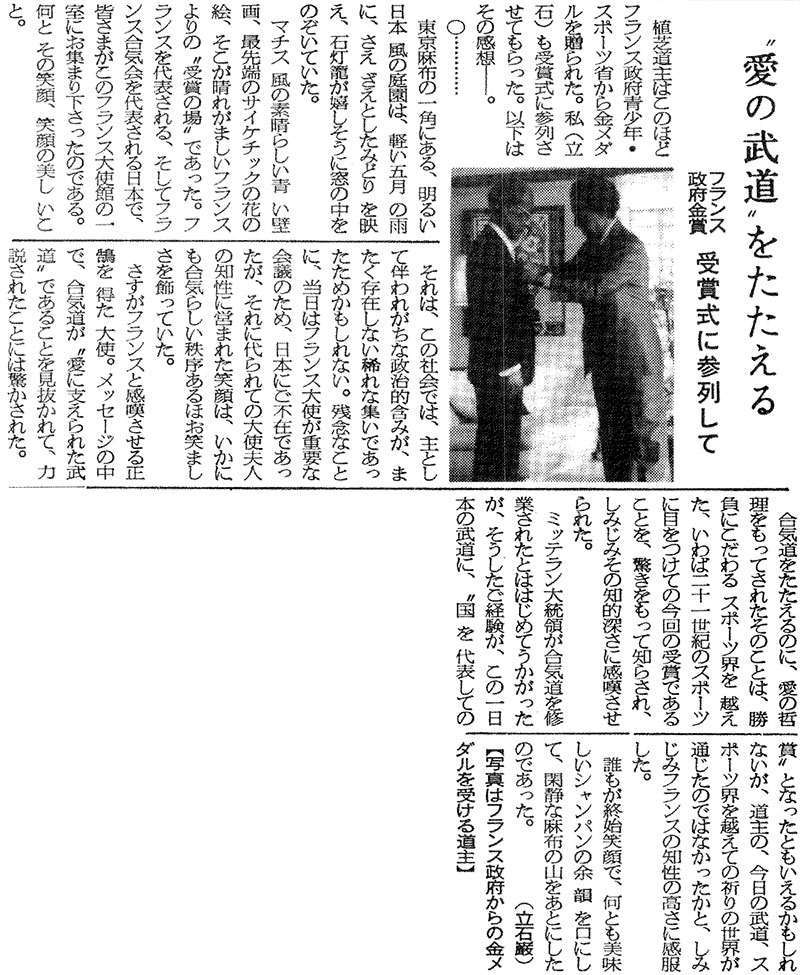 Report on the presentation of the Youth and Sports medal to Ueshiba Kisshomaru (Aikikai Journal, June 1990). The name of André Nocquet is not mentioned in the text.
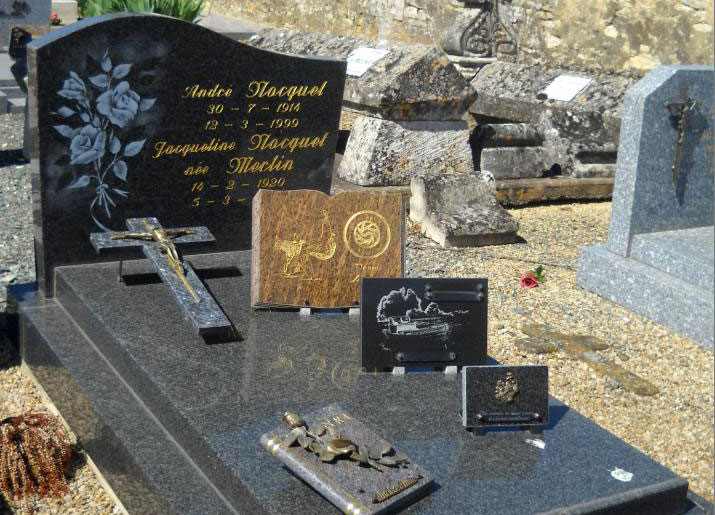
Nocquet was made Chevalier de la Légion d'Honneur on April 2, 1994. He died on March 12, 1999 at the age of 84 and was buried in Prahecq, his birthplace.
Note: Most of the archive pictures in this article were kindly provided to me by Tada Hiroshi Shihan, Kobayashi Yasuo Shihan, as well Mr Frank de Craene and Mr Claude Duchesne, the stewards of André Nocquet's archives. Many thanks to Odilon Regnard and Robert Cornman for their enthusiastic assistance with the collection and analysis of those documents.
