

This interview with Yoon Dae-hyun Sensei, the founder and president of the Korea Aikido Federation, was conducted during the organization's 30th anniversary celebration. Mihaly Dobroka and I were invited, along with Igarashi Kazuo Shihan, Takimoto Seizo Shihan, to give a class and a demonstration during that milestone weekend. I took the opportunity to ask Yoon Sensei to walk us through his martial arts background, and addresses controversial aspects of Korean and Japanese martial arts history, including the confused relationship between Korean Hapkido and Japanese Aikido, mythical figures like Shinra Saburo, and historical connections between key figures like Choi Yongseol and Ueshiba Morihei, while exploring the challenges of introducing Japanese martial arts in Korea and how Aikido's philosophy of peace and harmony offers solutions to modern social challenges.
Guillaume Erard: I heard that your father also practiced martial arts. Can you tell us about him?
Yoon Dae-hyun: My father was a Taekwondo master. He operated a Taekwondo dojo from the 1960s. Taekwondo in Korea began spreading through the military, and my father learned Taekwondo from a soldier who had learned it in the army, which is how he came to teach Taekwondo. I started practicing both Taekwondo and later Hapkido from when I was very young - around the age of four. I was born in the dojo, so to speak.

When I was young, my father's dojo was my playground. My entire daily life took place in the dojo, so I've lived almost my entire life in the dojo until now. Except for when I went to the military, I've lived almost entirely in the dojo.
Guillaume Erard: Did you also start training martial arts at your father's dojo?
Yoon Dae-hyun: Originally, my father first practiced Taekwondo, but later there were some problems with Taekwondo. The person known as the founder, General Choi Hong Hi, went into political exile to Canada. My father was also confused during that time, and that's when he adopted a new martial art - Hapkido. Not Aikido, but Hapkido. So from a young age, I practiced both Taekwondo and Hapkido together.
Guillaume Erard: Please tell us about those martial arts you practiced before starting Aikido.
Yoon Dae-hyun: Before going to the military, I was 4th dan in Taekwondo and 5th dan in Hapkido. I continued teaching Taekwondo in the military and was discharged. I was discharged around August 1984, and after discharge, people around me encouraged me to compete in fighting competitions, so I started with the rookie championship. I won the rookie championship and then won the fighting championship in 1985.

Even before that, in 1978, there was a Hapkido championship held in Daegu, which is the birthplace of Korean Hapkido. I competed as a Seoul representative and won the championship at that time. I practiced Taekwondo, Hapkido, and fighting competitions before encountering Aikido. What's particularly interesting is that while doing fighting competitions, I was looking for something more practical in real combat, which led me to Thailand. I learned about Muay Thai and went to Thailand to bring back a Muay Thai trainer to promote it in Korea. Looking for stronger martial arts led me to Muay Thai, and after that, I came to know Aikido.
Guillaume Erard: How did you find out about Japanese Aikido? What was your impression of it?
Yoon Dae-hyun: In December 1988, I went to Taiwan for an exchange - a Hapkido exchange. The Taiwanese call Hapkido "Hechitao." The Japanese call it Aikido, Koreans call it Hapkido - they were all the same thing. So I went to Taiwan and saw Aikido for the first time. When I first saw it, there were women and elderly people coming out and performing very softly and naturally, while we were hitting, kicking, flying around, and showing such things. When I first saw Aikido then, I was very shocked and refreshed. I thought, "So there is such kind of a martial art."
Guillaume Erard: In your experience, how is Japanese Aikido different from Korean Hapkido?
Yoon Dae-hyun: In English-speaking countries, Hapkido and Aikido are different. In Chinese-speaking countries, Hapkido and Aikido use the same Chinese characters, which is the source of some confusion. Korean-style Hapkido involves competitions similar to Taekwondo, so if you call it Korean-style Hapkido, it's similar to competitive Taekwondo with self-defense techniques of joint locks and throws. But during competitions, the joint locks and throws don't work well, so they compete like Taekwondo. It's completely different from Aikido. As you know, Aikido doesn't have competitions, and the spirit and philosophy of Aikido are completely different from Korean Hapkido.
Guillaume Erard: A person named Shinra Saburo appears in the history of Hapkido, as well as the history of Daito-ryu, the origin of Aikido. Is this the same person?
Yoon Dae-hyun: It's the same person, but there was some misunderstanding. When Korean Hapkido practitioners were searching for their history, they encountered a book written by Professor Tomiki, who created a Japanese sports-style Aikido. On page 232 or so, while explaining Daito-ryu, a person named Shinra Saburo Minamoto no Yoshimitsu is mentioned.

Shinra Saburo Minamoto no Yoshimitsu
Shinra Saburo Minamoto no Yoshimitsu was a samurai, and Minamoto was the family that opened Japan's shogunate period. The surname Minamoto is pronounced "Won" in Korean. So when you pronounce Shinra Saburo Minamoto no Yoshimitsu in Korean, it becomes "Shinra Samlang Won Uigang." The confusion came from the name "Shinra Samlang Won Uigang." When Professor Tomiki mentioned Shinra Saburo Minamoto no Yoshimitsu, he was talking about the Won family (Minamoto clan) that opened the shogunate period, but when Koreans read that pronunciation as it is, they could mistake it for a Korean person. Since Silla was one of the three kingdoms before the Joseon period (Goguryeo, Silla, Baekje), they misunderstood it as a person from ancient Silla. Then "Samlang" was mistaken for a military rank of that time. But "Samlang" originally means the third son. The second is "Jirang" (Jiro), the third is "Samlang" (Saburo), and the first is "Taro." They mistook this "Samlang" (third son) for a rank. So they mistakenly thought it was Won Uigang with the rank of Samlang from the Silla period. This led to the misconception that Won Uigang was Korean, and thus the founder of Hapkido was Korean. This is incorrect information, and this error has been widely corrected now.
Guillaume Erard: Both Choi Yong-seol and Ueshiba Morihei were students of Takeda Sokaku, but Ueshiba Morihei started training in 1915, and Choi Yong-seol began training with Sokaku much later, in 1942. Even though Ueshiba Sensei is clearly the senior, some say that Choi Yong-seol taught Ueshiba the techniques in Hapkido.

Choi Yong-sool (Korean: 최용술; Hanja: 崔龍述; November 9, 1904 - June 15, 1986)
Yoon Dae-hyun: Those stories don’t sound plausible at all. Also, there's a significant age difference between Ueshiba Morihei Sensei and Choi Yong-seol. When Choi Yong-seol was in his teens, Ueshiba Morihei Sensei was in his thirties, so it seems strange to say he taught him. Furthermore, the only record at our disposal reveals that Choi Yong-seol Sensei attended one of Takeda Sokaku Sensei's seminars for ten days. We have no idea how much he actually learned.
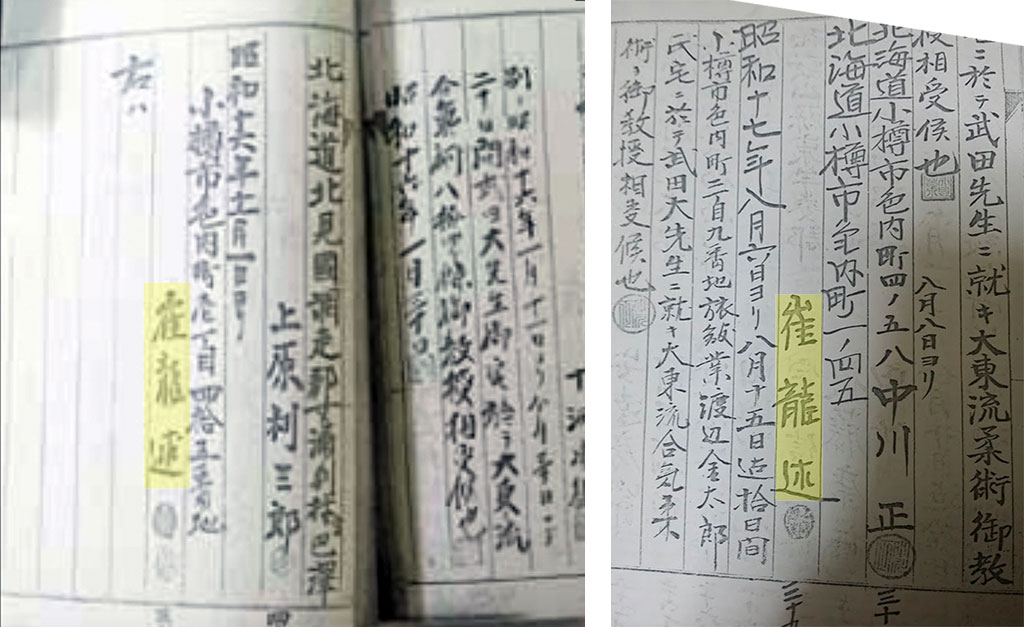
Takeda Sokaku's eimeiroku record. The page on the left shows 37 years-old Choi Yong-sool (崔龍述)'s name, with the location in Otaru (Hokkaido) and the date November 1st, 1941. However, the record is incomplete, as can be seen in the truncated sentence started with "右は", which would usually be followed by information, including the name of the instructor. It is therefore unclear how long of an instruction, if any, he might have received at that time, and from whom (some source argue that Choi mainly learnt from Yoshida Kotaro, rather than Takeda Sokaku). The page on the right indicates that 38 years-old Choi Yong-sool (崔龍述) received instruction in Daito-ryu Aikijujutsu at Watanabe Kintaro's house in Otaru (Hokkaido) for 10 days from August 6th to 15th, 1942. This short period of study is the only evidence we have, and it took place 20 years after Ueshiba Morihei had become a licenced Daito-ryu instructor.
Additionally, there are even stories that Choi Yong-seol introduced Ueshiba Morihei Sensei to Takeda Sokaku Sensei, but this also seems to be false. The person who introduced Ueshiba Sensei to Takeda Sokaku Sensei was Yoshida Kotaro, a newspaper reporter from Hokkaido. Interestingly, Choi Yong-seol's Japanese name when he was in Japan was Yoshida. He used the surname Yoshida Asao (吉田朝男) or something like that. There's a story that there might have been a Korean working at Yoshida Kotaro's house. An American martial arts instructor mentioned this story, and some people think that might have been him. We don't know the exact facts though, since it's not certain. So there's some mystery about why he used the name Yoshida. I think the story that Choi Yong-seol (Yoshida Asao) introduced Ueshiba Sensei to Takeda Sokaku Sensei is false.

Excerpt from the book Daedongmu (대동무). The top picture is described as: “Erased photo of Yoshida Asao (Yeongam Yeonggam)”. The second photo states “This is a photo of Master Minamoto no Masayoshi (源正義) and his disciples. The second person from the left in the back row has been erased. From the outline of the figure, it is clearly Yoshida Asao. — Provided by the Shirataki (白滝) Board of Education —”. In reality, this picture was taken at the Asahi Newspaper dojo in Osaka around 1937, several years before the first record of Choi training in Hokkaido. The person who appears blurred in the picture is Akune Masayoshi (阿久根 政義), a Kendo 5th dan from Kagoshima Prefecture. More information about this picture and practice under Takeda Sokaku in Osaka at the time is available here.
Guillaume Erard: There are stories about Ueshiba Morihei Sensei going to Manchuria and Mongolia before the war, but did he have any connection with Korea?
Yoon Dae-hyun: During World War II, there was a movement by the Japanese government to organize martial arts organizations. At that time, he went down to Iwama in the countryside to avoid stress and just rested there. When he came to Iwama, he met the last prince of Korea, Prince Yeong, known in Japanese as Rigin (李垠). They met each other when Prince Yeong came to Iwama. Someone introduced them - I can't remember the name right now, but the person who was managing Prince Yeong's health introduced them, and they met and talked about Aikido. Prince Yeong seems to have been very moved at that time by Ueshiba Sensei's love for humanity and Aikido as a martial art of peace. He was very impressed by this.

Yi Un (Korean: 이은; 20 October 1897 – 1 May 1970)
So Prince Yeong invited him to his house and they trained together. At that time, he gave financial support to Ueshiba Sensei, and I understand he continued to provide financial support several times until the end of World War II. I believe it was a considerable amount. When Ueshiba Sensei came down to Iwama, I understand he didn't have the large shrine or extensive land that we know of today. In Kisshomaru Sensei's biography of Ueshiba, there's content mentioning that he was able to buy land in Iwama with the financial support he received. So I think Prince Yeong was probably his sponsor.
Guillaume Erard: How did you connect with the Kobayashi Dojo in Japan?
Yoon Dae-hyun: As I said before, in December 1988, I went to Taiwan to demonstrate and exchange. That's when I first encountered Aikido, and at that time, through an introduction in Taiwan, I was invited to go to Japan together. So in 1989, the following year, there was a 20th anniversary event at Kobayashi Dojo. I participated in the 20th anniversary event. We demonstrated Korean Hapkido there. There were some very shocking incidents and various things happened. That's where I first met Kobayashi Yasuo Sensei. Then in 1990, I went to Taiwan again and met with Kobayashi Sensei, and Kisshomaru Sensei was also there. That's when I grasped what kind of martial art Aikido was. I understood that Aikido was a really good martial art, and then I went to Kobayashi Sensei's dojo. I went around 1992 or 1993, but since I was someone who had done fighting competitions, I thought of Aikido somewhat lightly. I thought it would be easy. But when I went there, I realized this was not an easy martial art at all, not something to take lightly. Kobayashi Sensei's techniques were very solidly based on fundamentals.

Yoon Dae-hyun and Kobayashi Yasuo Shihan
And nowadays, young people try to look very cool. There's a lot of excessive performance involved. In Taekwondo, you see people flying through the air, which looks very cool. In Karate, there's the one-strike kill concept where you knock someone down coolly with one strike, trying to look very impressive. Aikido is the same. Without knowing whether the techniques actually work or not, there's this tendency, especially among young people, to focus on performance just to look cool. I was probably like that too. But Kobayashi Sensei focused on fundamentals, making the martial art very natural and soft, and rather than flashy decoration, you could clearly feel that these techniques actually work, that the techniques are actually effective. In that regard, I thought Kobayashi Sensei's techniques were special. If he had shown flashy techniques at that time, I wonder if I would have pursued it, because I had those firm ideas from my fighting competition background. If Aikido had appeared that way then, I sometimes wonder if I would be doing Aikido now.
I think I was very fortunate to meet Kobayashi Sensei. Kobayashi Sensei still believes that training among members should be enjoyable, so the atmosphere in the dojo is very good. I think Kobayashi Dojo is excellent in that regard.
Guillaume Erard: I believe you also practice Katori Shinto-ryu. What prompted you to start?
Yoon Dae-hyun: At the 1989 20th anniversary event of Kobayashi Sensei's dojo, we also participated. I saw them doing sword practice there. So I learned that Aikido also includes swordsmanship. I asked Kobayashi Sensei to teach me, but actually, I knew nothing about Japanese swordsmanship. Later, because I was so curious, I even wrote a book about it.
I created a book about the history of Japanese swordsmanship and even published it under the title "Classical Swordsmanship and Aikido." Before that, I initially knew nothing, so I rudely asked Kobayashi Sensei to please teach me Katori Shinto-ryu, which wasn't really proper of me. When I asked him to teach me, he introduced me to Igarashi Sensei. Igarashi Sensei came to Korea and after teaching a few times, he introduced me to Sugawara Tetsutaka Sensei, who is from the Katori school. Since then, we've been inviting Sugawara Sensei every year and have been exchanging for more than 20 years now.

Yoon Dae-hyun and Sugawara Sensei
Guillaume Erard: Do you use your experience in Katori in your Aikido training? Please tell us about the connection between Aikido and Katori.
Yoon Dae-hyun: Sugawara Sensei comes every year to teach. When you look at swordsmanship, it seems simple - it's all about cutting and thrusting - but from that, numerous schools have branched out, each with different characteristics. I understand that Ueshiba Morihei Sensei also had deep knowledge of Katori, and he also had deep knowledge of Kashima Shinryu. So I couldn't help but be interested. Once I started practicing swordsmanship, I came to understand why Aikido does things the way it does. The part I couldn't understand at first was why, when fighting, you attack like this. I couldn't understand this. Even now, many people don't understand this. People who practice other martial arts wonder why we do shomen-uchi (frontal strike) - I also found it puzzling. But later I came to understand.
I realized that Aikido was a martial art based on the sword, and swordsmanship helped me understand Aikido techniques tremendously. By understanding swordsmanship, I came to understand why Aikido was done this way. Without practicing swordsmanship, there would have been many things I couldn't understand and would have overlooked, but by practicing swordsmanship, my technical understanding of Aikido deepened considerably.
Guillaume Erard: When did you establish the Korea Aikido Federation?
Yoon Dae-hyun: When I first went to Taiwan in 1988, there was no freedom of travel in Korea yet. It wasn't liberalized for travel. So while it wasn't difficult to go individually, when going as a group, you needed approval from the head of a social organization or corporation. When I went to the Hapkido organization and asked for permission to go to Taiwan as a group for exchange, they said no because it wasn't an association-level trip, they weren't sending us as an association. So I couldn't get permission. I had no choice but to go to another organization, which was a social organization. When I went there, I paid money and got their signature for permission, and that's how I first went to Taiwan in 1988.
But then I would need to go out again, which would be difficult again. So my father suggested we create our own social organization, and he organized it. We created the Korea Hapkido Promotion Association. We got approval from Seoul City and became an official social organization. It was registered with the Aikikai Foundation in 1996.
Guillaume Erard: There are many photos of teachers on the poster for the demonstration tournament. Who are the teachers who have come to teach the Korea Aikido Federation?
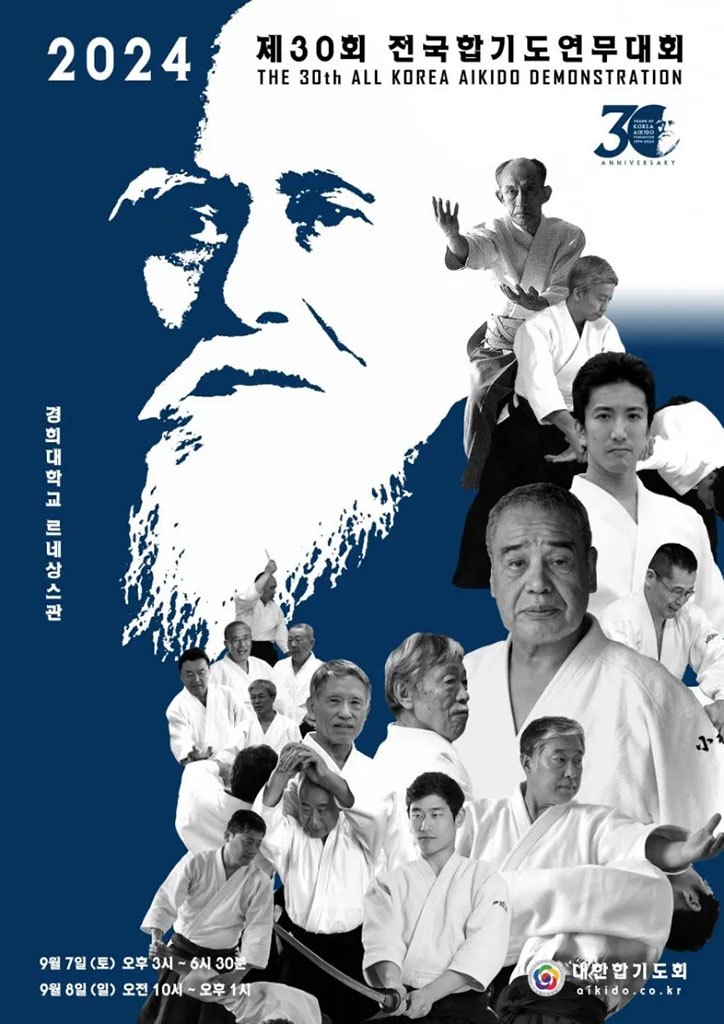
Yoon Dae-hyun: The reason we made this poster this time is that the center of Korean Aikido started from Kobayashi Sensei, so in order not to diminish the legitimacy and quality of Aikido, we thought we should work together with the Aikikai Foundation. As a branch of the Aikikai Foundation, we tried to express the teachings we received from Kobayashi Sensei. So we put the photo of the Aikido founder as the representative, followed by Kisshomaru Ueshiba Sensei who continues the lineage, then the 3rd generation Moriteru Ueshiba Sensei, and now Mitsuteru Dojo-cho in the center.

Igarashi Kazuo, Ueshiba Kisshomaru, Yoon Dae-hyun, Ueshiba Moriteru, Kobayashi Yasuo
On the left side is Ishibashi Ryoichi Sensei, who came to exchange with Korean members and started exchanges together. He came frequently, and after that, my eldest son Yoon Jun-hwan trained as an uchideshi at the Hombu Dojo. While staying in Japan at that time, he received a lot of help from Ishibashi Sensei. Starting with him, then Hatayama Sensei, Arai Sensei, Yamawaki Sensei, and Kobayashi Sensei's group. From the Hombu Dojo, several people including Sugawara Shigeru Sensei came. Now there's Umetsu Sho Sensei, who has been coming to teach for several years now. In between, there was Kobayashi Sensei and Igarashi Sensei. Igarashi Sensei is like a big brother to me. Since I don't know much about various situations in Japan, I ask him questions and seek advice about such matters, and he comes and teaches very well. I learned a lot this time too. I'm very grateful for his excellent teaching. Then there's Takimoto Seizo Sensei, who was originally in business. So he's involved in business, martial arts, Aikido, and he's the representative of Nagoya and president of the Nagoya Association. I feel and learn a lot from Takimoto Seizo Sensei. Because he combines both literary and martial arts, it's even more impressive.

Yoon Dae-hyun and Yoon Jun-hwan at Hombu Dojo
So we made the poster including those who had the most influence.
Guillaume Erard: Please tell us about the process leading up to the Aikikai recognition.
Yoon Dae-hyun: Kobayashi Sensei helped with joining the Aikikai. Since the Aikikai continues the spirit and philosophy of Ueshiba Morihei Sensei, I thought that anyone practicing Aikido should naturally work together with the Aikikai, so we joined. Initially, we registered as a social organization in 1996, and then in 2001, we changed to a corporate body. We became a social corporation, and that's how we've continued as the Korea Aikido Federationuntil now. We invite teachers from the Hombu Dojo every year, working to ensure that the quality of Aikido doesn't decline.
Guillaume Erard: Many aikidokas from overseas came to the martial arts event at the Chungju event in 2019. Since when have you been connected with the IAF?
Yoon Dae-hyun: We joined the International Aikido Federation in 2008 by unanimous vote of attending members at the general assembly. When the World Martial Arts Masterships were held in Korea in 2019, many teachers from the International Aikido Federation came, and we were actually very nervous at that time. We had all our members gather to participate in the event. Since joining the International Aikido Federation in 2008, we participate in every event they hold. That's how our activities have been with the International Aikido Federation.
Guillaume Erard: How many people currently practice Aikido in Korea?
Yoon Dae-hyun: Now, precisely, there are about 600 people nationwide - about 600 people. There are about 30 dojos, dojos and clubs together, and the number of people practicing is about 500 to 600. When we hold events, usually about 200 people gather for events, and at this 30th anniversary event, about 200 people gathered for the event.
Guillaume Erard: With the difficult relationship between Japan and Korea, how did you get Koreans interested in Japanese martial arts and teach them?
Yoon Dae-hyun: That was difficult. When accepting Aikido, it was hard because of the deeply rooted feelings about Japan, so overcoming that part was very difficult. Kendo and Judo are known by many Koreans in Korean terms. Because they became daily practices during the long settlement process, there's no such issue, but with Aikido, there was some conflict in that regard. However, I think we were able to sufficiently overcome this through Ueshiba Morihei Sensei's mind, spirit, and philosophy regarding world peace. Now Aikido has become widely known as a very good martial art for Koreans too. I'm not too worried about that part now. Initially, I worried a lot about that part.
Guillaume Erard: Please tell us about your conception of the spirituality of Aikido. How is the Japanese martial art of Aikido useful in the daily lives of Korean people?
Yoon Dae-hyun: I was taught from childhood to "start with courtesy and end with courtesy." I learned that from my father too, so "start with courtesy, beat each other up, and then end with courtesy again" - starting with courtesy and ending with courtesy means not holding grudges. I started martial arts with that thinking and had such thoughts until I encountered Aikido. But what changed my thinking after encountering Aikido was that life in the dojo should be applied as it is outside as well. So life outside and dojo life shouldn't be completely different - it's not a dojo where you come stressed out and then release all your stress here. That's not what an Aikido dojo is.
In an Aikido dojo, the teachings, spirit, and philosophy learned in the dojo should be applicable outside as well. So it doesn't encourage fighting but makes you refrain from fighting, not create enemies, and not cause any disturbances. I think these aspects greatly improve human relationships. Since Aikido's basic idea is that we should cooperate with each other, these aspects are necessary for Koreans. When you look at Koreans, there's a lot of conflict. They are under a lot of stress and the competition is too intense, so the suicide rate is very high - there are stories that it's the highest in the OECD. From childhood, from school days, the competition to get into good universities, then get good jobs, good workplaces - the competition is so intense that there's a lot of trying to push each other down to climb up. I think it's probably similar everywhere in the world, but I think Korea's competition is particularly intense. I think Aikido can provide answers to such issues.
So I thought that Aikido is truly a necessary martial art for Koreans. Kendo also makes people very impressive, and Judo is also an excellent martial art, but I thought the harmony with each other and peace of mind that we need in daily life - these things are absolutely necessary. So although Aikido is a Japanese martial art, I personally think it should definitely be established in Korea - it should be established even more than Kendo or Judo, and I decided to promote Aikido.
Guillaume Erard: On your webpage, it was written that today's event is "a transition from the predecessors who supported the Korean Aikido Association to the new generation of leaders." Please tell us about the future of Aikido in Korea that you envision.
Yoon Dae-hyun: For 30 years, we first invited Kobayashi Sensei in 1994. From then on, many Japanese teachers have continuously come - a tremendous number of teachers have come. Such relationships will continue in the future, and since joining the International Aikido Federation, we've come to know many famous teachers from Europe and Asia. In the future, as Korean Aikido expands further, we plan to invite teachers from Europe and Asia and create exchanges among members.

Yoon Dae-hyun presenting a commemorative plaque to Guillaume Erard for his teaching participation during the Korea Aikido Federation's 30th anniversary event.
Until now, since we knew too little about Aikido, we were in a position of receiving, but for the next generation - I think my eldest son Yoon Jun-hwan should lead the generation to come - now shouldn't we expand Aikido further? Until now, I worked hard to learn - to understand what kind of martial art Aikido was - but from now on, I think we should work to expand it together. I'm very interested in how Aikido will change in Korea as the next generation leads it. I plan to continue watching with interest.
Many thanks to Mihaly Dobroka for his help in the preparation of this interview.
